Berlin Film Festival opens with 'The Grandmaster'


BERLIN (AP) Martial arts epic "The Grandmaster" kicked off the Berlin Film Festival on Thursday, introducing an international audience to Yip Man, the man who mentored Bruce Lee and brought kung fu to the masses.

The movie by Wong Kar-wai is running out of competition because the director also heads this year's jury.

Shanghai-born Wong and his fellow jurors among them American actor-director Tim Robbins will have to choose from 19 movies competing for prizes at the 63rd Berlinale.

These include the Steven Soderbergh thriller "Side Effects" with Jude Law and Catherine Zeta-Jones, and Gus Van Sant's film "Promised Land" about the shale gas industry starring Matt Damon.

Juliette Binoche portrays a troubled French sculptor in "Camille Claudel 1915," while "Gold" tells a tale of German immigrants seeking their luck in late 19th-century North America.

Competing also are romantic thriller "The Necessary Death of Charlie Countryman" with Shia LaBeouf and Evan Rachel Wood, and "Closed Curtain" by Iranian film maker Jafar Panahi, who was barred from leaving Iran to attend the festival.

The winner of one award has already been announced. French filmmaker Claude Lanzmann will be honored for his life's work. Lanzmann's nine-and-a-half hour documentary "Shoah" about the horrors of the genocide of European Jews was screened at the festival in 1986.

In total more than 400 films will be shown at the Feb. 7-17 event known for its focus on social and political works.

Jury president Wong said ahead of the festival that Berlin was about the "experience of a true pleasure of sharing ideas" in the cinema.

Speaking Thursday about his own work, Wong told reporters that the biggest challenge while making "The Grandmaster" was the fact that he doesn't practice martial arts himself.

Wong said he was nevertheless drawn to the figure of Yip Man, Bruce Lee's mentor, because of his fortitude in the face of a lifetime of hardship, beginning with his childhood in Imperial China through the revolutionary years and ending in Hong Kong under British colonial rule.

"His life basically is like the modern history of the early days of our republic," said Wong. "During all these periods you can see how a martial artist stands up for his principles and his honor in front of all this hardship"

The international cut of "The Grandmaster" premiering in Berlin has been shortened from the version released in China last year. The film stars Tony Leung ("In the Mood for Love") and Zhang Ziyi, best known internationally for "Crouching Tiger, Hidden Dragon."

____

Festival website: http://www.berlinale.de

BlackBerry to stop selling handsets in Japan - Nikkei


(Reuters) - BlackBerry will stop selling smartphones in Japan, partly because the company cannot justify the cost of modifying its operating system to accommodate the Japanese language, the Nikkei business daily reported.

BlackBerry's market share in Japan has shrunk to 0.3 percent from 5 percent, the daily said.

BlackBerry could not be immediately reached for comment.

The company, which changed its name from Research In Motion when it launched its new BlackBerry 10 smartphones a week ago, will continue to offer support to existing users, the Nikkei said.

(Reporting by Sayantani Ghosh in Bangalore; Editing by Supriya Kurane)

Robin Roberts set to return to 'GMA' on Feb. 20


NEW YORK (AP) ABC News says Robin Roberts will be back on the job at the "Good Morning America" anchor desk on Feb. 20. Her return will be five months to the day since her bone marrow transplant to treat a rare blood disorder.

Roberts has gotten the all-clear from her doctors, according to the announcement made Thursday on "GMA." She reached the critical 100-day benchmark in December.

In January, she began a series of dry runs at the "GMA" studio to re-acclimate herself to the work routine.

Her last day on "GMA" was Aug. 30 before she started her medical leave.

About a year ago, Roberts began feeling the symptoms of her illness, known as MDS.

She said in a statement: "What a difference a year makes."

___

Online:

http://abcnews.go.com/

German bin-divers get connected to wage war on food waste


BERLIN (Reuters) - Just past midnight behind a Berlin supermarket, two youngsters with torches strapped to their woollen hats sift through rubbish bins for food that is still edible, load their bikes with bread, vegetables and chocolate Santas and cycle off into the darkness.

It is not poverty that inspires a growing number of young Germans like 21-year-old student Benjamin Schmitt to forage for food in the garbage, but anger at loss and waste which the U.N. Food and Agriculture Organisation estimates at one-third of all food produced worldwide, every year, valued at about $1 trillion.

In environmentally aware, cost-conscious Germany, "foodsharing" is the latest fad, using the Internet to share food recovered from supermarket bins while it is still in good condition.

"Dumpster-diving" for society's cast-offs is a fast-growing phenomenon among sub-cultures in Europe and the United States and "freegans" - vegans who do not believe in paying for food - have long been sifting through supermarket wheelie bins.

But the "foodsharing" movement that has sprung up in cities like Cologne and Berlin brings efficiency and technical skills to the table in ways that make it uniquely German.

More than 8,200 people across Germany have registered to share food on the www.foodsharing.de website in just seven weeks of existence, said Berlin organiser Raphael Fellmer.

The website - which has an appropriately recycled-paper look - advises people where there are "baskets" and what is in them: organic sausages in Cologne or spaghetti and Darjeeling tea in Chemnitz. Members can log in or use a Smartphone app to see the address of nearby baskets or a pick-up time and place. They can then rate the transaction like ordinary online retailers.

For people who cannot afford the Internet, Fellmer has set up the first of what he hopes will be many "hot spots" where food can be picked up anonymously: a fridge at a covered market in Berlin's Kreuzberg, where anyone can help themselves to food.

"I've come for some bread rolls, just a couple," said Frank, an unemployed 47-year-old, who was alerted to the location of a hoard of fresh bread on the website and called at Fellmer's house.

Opening his rucksack, he helped himself from a bag of rolls that had been on sale at a nearby bakery till 7 p.m. the previous evening.

TASTE THE WASTE

Throwing away food is a rich country phenomenon but a poor country's problem.

Camelia Bucatariu, a policy expert on food waste at the FAO in Rome, said North American and European consumers waste 95-115 kg of food per capita a year, compared to just 6-11 kg in sub-Saharan Africa and southeast Asia. As economies develop, the level of food waste grows, said Bucatariu, who is Romanian.

The foodsharers' argument that the tonnes of food wasted in Germany could feed people in poor countries is not as simplistic as it sounds: less waste means less drain on resources in the producer countries and less upward pressure on prices, she said.

"It is not only wasting an apple, but wasting the resources embedded in that apple which may be produced outside of Europe," Bucatariu told Reuters. As well as economic damage there is the cost to the environment of using energy to grow food that ends up in a landfill site, emitting greenhouse gases like methane.

The FAO is studying how to change such behaviour and whether changes are needed to legislation on the retailers' "date marks" differentiating "Best By" from "Use By" - the latter being the date when food may start to become a biological hazard.

Fellmer is on a three-year-old "money strike": he does not earn or spend a euro and he, his wife and child eat only food that has been rescued from the bins.

A rangy 29-year-old in a baggy blue jumper with spiky blond hair and a pointed beard, he is already something of a German media phenomenon. On a recent visit, a TV documentary crew and a reporter from a local daily were crowded into his one-room flat.

He plonks on the table a packet of ginger biscuits for Christmas - from a batch of hundreds fished out of bins nearby - bearing a "use by" date which is still a month away. They taste fine, as do some red and gold-wrapped chocolate Santas.

The "use by" dates infuriate the foodsharers, many of whom were first inspired by the 2011 film "Taste the Waste" by their guru Valentin Thurm.

It documents waste ranging from farmers discarding tomatoes that are not red enough to bakeries burning the excess bread they made to keep the shelves looking full until closing time.

Fellmer's friend Schmitt was brought up in a "very food-conscious vegetarian household". His mother is a food chemist who advises him on hygienic ways to eat and share food from plastic sacks that he admits are sometimes "mushy" under your fingers in the dark.

Like Fellmer, he lives not in east Berlin, with its history of squats and communes, but in the leafy western suburb of Dahlem where he bin-dives under the noses of the German capital's most affluent residents.

Foodsharing appeals to the "hipster" culture of Berlin with its tradition of anti-establishment protest, Schmitt said.

The German crowdsourcing techniques could turn out to be "best practice" for reducing waste in other countries too, said the FAO's Bucatariu.

"Solutions may vary according to the culture, the context and to what access to food there is," she said. "But each and every one of us can do something."

(Additional reporting by Fabrizio Bensch; Editing by Gareth Jones and Sonya Hepinstall)

Video game composer taking 'Journey' to Grammys


LOS ANGELES (AP) Austin Wintory still can't wrap his head around the fact that he's up against "Star Wars" composer John Williams for a Grammy Award.

"Thank God I've been so busy in the last few weeks since the nominations came out because I don't think my brain could ever possibly comprehend that," said the 28-year-old composer. "He's a lifelong idol of mine. I don't think it's something I could have ever even dreamed."

Wintory is facing 80-year-old Williams and his score for "The Adventures Of Tintin" at the Feb. 10 ceremony, as well as the scores to "The Artist" by Ludovic Bource, "Hugo" by Howard Shore, "The Dark Knight Rises" by Hans Zimmer and "The Girl with the Dragon Tattoo" by Trent Reznor and Atticus Ross.

The biggest difference between Wintory and his competitors? His score is from a video game.

Wintory's nomination for the artsy PlayStation 3 game "Journey" marks the first time a game score has been nominated for a Grammy. Music from games have been eligible since 2000 when "other visual media" were added to Grammy categories previously reserved for music from film and TV. When the Grammys were overhauled in 2011, the category was renamed to "best score soundtrack album for visual media" to fairly encompass all mediums.

Wintory, a first-time nominee who also creates film scores, sees his nod as an opportunity to showcase the creativity of games.

"I don't have any interest in being that one game soundtrack for someone who doesn't own any game soundtracks," said Wintory. "I can think of no higher purpose than if 'Journey' were to be someone's gateway drug, so to speak, to discovering much more when it comes to interactivity."

The score for "Journey," which casts players as a mysterious scarf-draped figure who wanders a desert landscape, is an exotic mix of mystical and introspective ditties led by powerful cello solos. Wintory said he tweaked and re-tweaked the score for three years with the "Journey" developers from thatgamecompany.

If Wintory wins at the Grammys, he wouldn't be the first game composer to take home a gramophone.

Christopher Tin won the trophy for best instrumental arrangement accompanying vocalists in 2011 for "Baba Yetu," the Swahili-language song originally featured in the 2005 strategy game "Civilization IV." That tune served as the opening track on Tin's debut album, "Calling All Dawns," which was also honored that year as best classical crossover album.

Unlike other awards that honor music from games, the Grammys solely judge game scores on their soundtracks, just like they do for scores from film and TV. Bill Freimuth, the recording academy's vice president of awards, said entries of game scores doubled since the category was renamed to encompass all visual media.

"For some reason, that worked some magic with the video game community," said Freimuth. "They didn't feel like they were outsiders. They were part of the main batch."

Tommy Tallarico, a video game composer and organizer of the "Video Games Live" concert series, was among the artists who originally petitioned the recording academy to add game scores to awards consideration. He believes Wintory's nomination is a landmark not only for composers who craft music for games but also the gaming industry as a whole.

"It really shows that the National Academy of Recording Arts and Sciences is starting to consider our work art now," said Tallarico. "It's on the same level as film and TV in their eyes, and that's an important first step because a lot of people, when they think of music from video games, they still think of beeps and bloops. That's not the reality anymore."

Freimuth of the recording academy said that while video game composers have lobbied for their own category in the past, it's an unlikely proposition given the current amount of submissions the academy receives from game composers. Besides, this year's awards have proven that a score from a game has no problem earning a nomination alongside a score from a film.

___

Online:

http://www.grammy.com

http://thatgamecompany.com/games/journey/

___

Follow AP Entertainment Writer Derrik J. Lang on Twitter at http://www.twitter.com/derrikjlang.

Hong Kong snake kings a dying breed


Hong Kong (Reuters) - When a king cobra lunges at Chau Ka-ling as the door to its wooden cage falls open in her busy Hong Kong restaurant, she just laughs, then pulls it gently into her arms.

For Chau is a "snake king," one of scores in Hong Kong who have through generations tamed snakes to make soup out of them, a traditional cuisine believed to be good for the health.

Yet the people behind providing fresh snakes for the savoury meal thought to speed up the body's blood flow and keep it strong in the cold winter months may be doomed, with young people increasingly reluctant to take on a job they see as hard and dirty.

"He is my boss, he supports my living," said Chau of the snake she cradled at Shia Wong Hip, a popular shop that serves over 1,000 bowls of hot snake soup on the busiest winter days.

Trained by her father in childhood to handle snakes, Chau, now in her early 50s, took over the business he founded, serving up a small bowl of soup for 35 Hong Kong dollars (2.8 pounds).

From boiling the essence out of snake, chicken and pig bones, to spicing it up with an array of ingredients that include five types of snake meat, the traditional southern Chinese snack can take more than six hours to make.

Yet as the cold deepens in the weeks leading up to the Chinese New Year and the Year of the Snake it ushers in on February 10, Hong Kong locals huddle inside small street shops like hers.

The thick soup is flavoured with hints of lemongrass, while the snake itself tastes like chicken but is tougher.

"Snake soup can help you stay healthy, and when the weather is cold it helps keep you from catching the flu," said customer Stephen Lau.

While soup stalls remain popular, scattered across the former British colony, retail snake shops have diminished to a slithery few, such as the 110-year-old She Wong Lam.

Inside, more than 100 snakes lie quietly in wooden cupboards labelled "poisonous snakes" as the clicks of an abacus echo through the dimly lit shop.

Shop owner Mak Tai-kong, 84, has been working there for 64 years. He sells an average of 100 snakes a week to restaurants and snake soup shops that could otherwise buy pre-butchered meat, but prefer the freshness he offers.

Over the decades, he has trained about 20 people to become snake handlers - and said he has a few tried and true tips to help people put aside their fear of the venomous creatures, including starting them out on snakes whose fangs have been pulled and thus are no longer dangerous.

"Then, after he has been bitten a couple times by a snake that is no longer poisonous, he will think, 'Oh, this is not painful, this is nothing, this is like being bitten by an ant,'" Mak said.

"Then he will no longer be scared, and as he works more he will get more used to it."

But new blood is hard to find. The youngest employee in the shop has now been there more than 30 years.

"There won't be many. Firstly, it's crummy and dirty, and snakes smell," Mak said. "Secondly, the wages aren't high. So not many people enter the field."

Mak feels his job is less about making money and more about providing a service to society by keeping a tradition alive.

Yet even fellow "snake king" Chau says she has no successors trained, and in fact has refused to do so.

"I've killed snakes for so many year, but actually I don't want to. Because there are fewer and fewer snakes now," she said. "But I can't make a career change. There's nothing else I can do."

(Reporting by Venus Wu; Editing by Elaine Lies and Paul Casciato)

Pianist's music fails to put tortoises in the mood


LONDON (AP) No wonder they're endangered.

Galapagos tortoises at London's zoo lumbered around impassively as famous French pianist Richard Clayderman serenaded them with music from his latest album, "Romantique."

The music an attempt Thursday to put the reptiles in the mood to mate appeared lost on the slow-moving giants.

Even a rousing rendition of "Chariots of Fire" did little to lift the tortoise's spirits. They only seemed to perk up when zookeepers brought them some carrots.

Galapagos tortoises are the largest in the world and can live for over 150 years. But the gentle animals have struggled to fend off predators and are now under threat.

Clayderman said that it was "funny to be here."

Python Challenge: Inside the world of Florida s snake hunters


Burmese python (Joe Raedle/Getty Images)

EVERGLADES NATIONAL PARK, Fla. -- On a lonely road stretching for miles through this vast reptile-infested wilderness, a silver Toyota Matrix screeches to a halt next to a wide pond surrounded by tall brown grass. Two men in their 20s, Josh Holbrook and Jason Thullbery, kick open their doors and spill onto the pavement. Holbrook, the driver, forgets to shift the transmission into park and lunges back through the window to stop the car from rolling into the water. From the backseat, Thullbery's wife Hannah points to the far end of the murky pond, where a 12-foot green and brown strip of flesh suns itself on the bank.

"Python!" she squeals. "Across the water!"

Holbrook squints at the reptile while scanning the marshland for a passage to the other side. It's at least one hundred yards away.

"I think we got one," he says.

***

The Florida Everglades has a severe invasive species problem, and the Burmese python, a snake that can stretch to 23 feet and weigh 200 pounds, is one of the park's biggest headache. The python, which is unnatural to the region, began showing up in the state's marshes and glades in the early 1990s and its hungry offspring have depleted the region's wildlife population. It is estimated that there are as many as 100,000 pythons slithering in the wild, and there aren't nearly enough snake hunters on the ground to make meaningful progress.

This year, the Florida Fish and Wildlife Conservation Commission launched The Python Challenge, a competition that brings Burmese python hunting to the masses. From Jan. 12 through Feb. 10 it is open season on the species, luring more than 1,500 people to hunt snakes in exchange for thousands of dollars in cash prizes.

During the Python Challenge, anyone can become a legal python hunter by spending $25 on entry fees and passing an online test. But three weeks into the competition, only 50 pythons have been bagged. In this long war between predator and prey, the hunted have the upper hand.

Holbrook, a graduate student at Florida Atlantic University and author of a field guide on South Florida snakes, has spent years trudging through the state's glades and forests. He and Thullbery aren't officially participating in the Python Challenge, but he has a special research permit that grants him access to the Everglades to collect pythons. Since 2008, Holbrook has caught more than 50 alone, which he delivers to state authorities.

Now, as he races along the dark pond, he's hoping to make one more addition.

Jason Thullbery hunts Burmese pythons in the Florida Everglades. (Chris Moody/Yahoo News)

***

There are many theories as to what brought the troublesome pythons into the state. Some blame Hurricane Andrew, which freed dozens of snakes from their owner's enclosures when it tore through South Florida in 1992. Some also blame irresponsible pet owners who bought a cute baby python only to discover that, as most living creatures do, they grow. Fed up, the owners let them sliver into the Everglades. Some pet dealers may even intentionally release them into the wild to create a breeding cash crop that they can come and collect later.

Lawmakers have taken steps to stem the problem--Florida banned the sale of Burmese pythons in 2008 and the federal government stopped all imports into the country in 201--but efforts were too little, too late.

Pythons are survivors--they can live up to 25 years in fresh or salt water, go months without eating, and females can lay up to 100 eggs at a time. Living near the top of the food chain, their numbers have swelled into the thousands in just a few years, putting the ecosystem's natural balance at risk.

They're also elusive, and even if you spot one, catching it is another matter entirely.

Chopping off the python's head can lead to a bloodied severed head bearing needle-sharp teeth chomping at your legs. A python brain can remain active for up to an hour after decapitation. Florida officials recommend killing the snake by firing a pressurized bolt into its brain or shooting it in the head with a gun.

Catching the python by hand without a weapon offers a trio of hunters three unappealing choices: Be the sucker who takes on the head and gets a bite on the arm; the sucker who grabs the midsection and ends up with a snake wrapped around your neck; or the sucker in the back who will almost always be covered in urine and feces -- a process known politely as "musking" a predator.

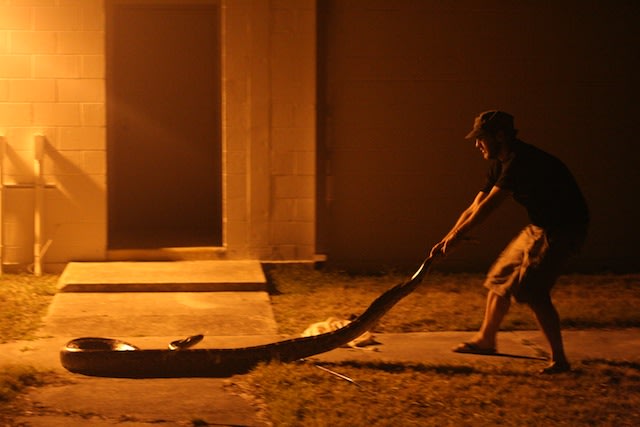
A solo hunter can nab the snake by hand, but the process requires a rope-a-dope game of grabbing the snake by the back of its tail and swinging it around. When the snake rears its head to strike, the hunter drops the tail to dodge. The process is repeated until the snake becomes too exhausted to retaliate. When that finally happens, stuff the snake in a bag, drive it to the nearest drop-off station, and take a shower.

Holbrook bags a 14.5 foot Burmese python in March 2009. (Courtesy of Josh Holbrook)

* * *

They call themselves "herpers."

With more than 40 snake species native in Florida, the state is home to a robust underworld of reptile enthusiasts who devote their weekends and disposable income looking for snakes. Holbrook is the co-founder and vice president of the South Florida Herpetological Society, a group of about 50 local snake lovers who meet monthly at a local exotic pet shop and go on field trips around the state.

Like any niche community, the herpers have their own parlance for the sport of snake catching. The word "herp," for example, can be used several ways. It's a noun ("That place was crawling with herps") or a verb ("Wanna go herpin' tonight?") The Everglades National Park, a popular place for spotting snakes, is almost always called the "ENT" and Holbrook's small sedan is called the "HRV"-- the "Herpetological Research Vehicle." The Burmese pythons are known simply as "Burms."

I meet Holbrook at his house in Lake Worth, where he lives with his wife, two dogs and a small zoo of reptiles. Caged between his guitars and a piano in the family "Herp Room," Holbrook owns no less than seven turtles, one Florida Pine Snake, a Southern Hog Nose Snake and two Boa Constrictors. He has two new snakes living under quarantine in his bedroom closet.

"That's all I've got for wild animals here," Holbrook says, looking around the room. "I think."

Holbrook is preparing for the first Herpetological Society meeting of the year, and tonight he's responsible for providing the raffle prizes. One lucky herper will win a pair of fire belly toads, which Holbrook picks up from his next-door neighbor, a reptile keeper from the Palm Beach Zoo.

Holbrook tosses the toads in a bag and drives down the street to "Wild Cargo Pets." Inside, a volunteer sets up a row of chairs and a projector surrounded by dozens of tanks filled with turtles, snakes, tarantulas and lizards. There's even a Burm coiled in the corner.

Before the meeting, a customer named Brian Jones walks in with a Florida Kingsnake wrapped around his hand and approaches Aaron Joyce, the store owner. "Hey man, can you sex my snake?" Jones asks Joyce. Assuming this does not mean what I thought it meant, I invite myself to follow Joyce and Jones toward his office. Joyce inserts a small metal probe into a slit near the end of the snake and diagnoses it to be male. Snakes lack external sexual organs, Joyce says, so finding the gender isn't as easy as peeking at their underbellies.Brian Jones of West Palm Beach holds his Kingsnake. (Chris Moody/Yahoo News)

It's time for the meeting to begin. Speaking over the sound of a squawking bird, chirping crickets and bubbling aquariums, the club officers proceed through a roster of official business. They announce this year's upcoming "Burm Bash" and crack snide jokes about those "crazy rednecks running around with guns, knives, swords and bats" who signed up for the Python Challenge.

During the meeting, I reunite with Joyce near the back, who is helping a customer with a bag of frozen dead rats.

Joyce tells me he welcomes the Python Challenge. He's frustrated, however, that when it comes to invasive species, lawmakers and the media focus almost exclusively on snakes. Feral cats are bigger threats to wildlife than snakes, he insists, but no one talks about them. (Somehow the movie Kittens on a Plane never made it past pre-production.) Wild pigs are a nuisance too, but there's no Creation story about how Satan took on the form of Babe and tempted Eve with a taste of his Forbidden Bacon.

Making it worse, the restrictions placed on snake ownership cost his small business thousands of dollars in revenue. To him, snake ownership should be regulated, not banned. It is a right. "If they can take away your right to own a snake," Joyce says, "they can take your Bible and your guns next."

* * *

Meeting concluded, the group decides to take the after-party at club member Fred Grunwald's house.

Grunwald is one of the oldest herpers in the group, and he has the collection to prove it. His property is teeming with wildlife--instead of cars in his garage, he has a 16-foot Tiger Boa and countless other snakes. Those seeking a Bud Light in the cooler in the driveway will be dismayed to find a Water Moccasin who has been living in there contentedly for 25 years. In the backyard, tortoises roam the grass next to caged enclosures filled with crocodiles and hissing alligators. Get too close, and the oldest crocodile makes it a habit of snapping at the chain link fence that separates the beast from her potential dinner.

At the Grunwald home, it is not uncommon on cold days for the family to bring some of the wildlife indoors. The smaller crocodiles, for instance, very much enjoy splashing around in the family bathtub. Fred's 16-year-old granddaughter, Brooke, spent her childhood sharing bathrooms with crocodiles, a practice that left her wondering as a child why the other girls in town were apprehensive about coming to her slumber parties. Speaking of sleepovers, Brooke tells me that on one particularly cold night years ago, one of their Caiman crocs found its way into Fred's bed, where they "cuddled" comfortably through the night.

After a thorough tour of the grounds, Fred bids us adieu from his snake sanctuary. Before leaving, I ask how long he's kept giant reptiles for a living.

"For a living?" he asks. "This is just my hobby."

This man, who has slept with crocodiles, breeds giant alligators and keeps rare exotic pets in his garage, is no biologist or zoo keeper.

"I work at a grocery store."

* * *

Josh Holbrook searches for snakes in Everglades National Park. (Chris Moody/Yahoo News)

The next morning Holbrook, Thullbery and Hannah hit the road for the day-long python hunt in the Everglades. The herpers scan the waterway as they drive, searching for signs life. A fleck of light reflecting from the sun; a sparkle in the water; a serpentine shape in the road ahead. They drive on, eyes peeled toward the rising sun.

That's when Hannah spotted the giant snake-looking creature on the side of the pond.

After he lept out of the car, Holbrook is blazing the trail through the grass with Thullbery trailing close behind. Halfway toward the bank, Thullbery missteps on the limestone and sinks his leg into the mud, but pulls himself out and presses on. Hannah is long hidden behind the grass by now, and shouts directions over the pond.

"Is it still there?" Holbrook shouts over the wall of grass toward Hannah, the lookout.

"Yes! Keep going around! You're almost there!" she shouts back.

With a new burst of hope, we push our way through.

"No! It's going in the water!" Hannah screams.

We reach an opening just as the last piece of flesh slithers into the pond. The next thing we see make our hearts sink.

That glistening line of dotted green that we had seen from far across the water was no python at all, but the tail of an enormous alligator whose upper body had been hidden beneath the water. The gator swims nearby as though only to taunt.

We retreat back to the Herpetological Research Vehicle, empty handed and our shoes soaked in mud.

In the end, no pythons were to be found that day. Even with experts like Holbrook on the hunt, most of the 99,000 Burms still slithering their way through the glades can rest easy. For now.

Burmese python tags in Everglades National Park. (Chris Moody/Yahoo News)

Australians win race to top of Empire State Building


NEW YORK (Reuters) - Australians Mark Bourne and Suzy Walsham were the fastest man and woman to race up the 1,576 steps of the Empire State Building on Wednesday in the run up of the iconic New York landmark.

Bourne finished in 10 minutes, 12 seconds and Walsham clocked 12:05 in the race up 86 floors that is described as a vertical marathon, the New York Road Runner (NYRR), which organizes the annual Empire State Building Run-Up, said.

About 600 runners from 18 countries took part in the race, now in its 36th year.

"Obviously I'm very happy to win and it's nice to have all the training pay off," said Bourne. "I wanted to pace myself well and fortunately it paid off."

Four-time champion Walsham was equally elated.

"I had a bear on my back after my crash in 2009 and I trained specifically for this race. It's a personal best time for me and I couldn't be happier," said Walsham who lives in Singapore.

Australian Darren Wilson came in second among the men, followed by Ricky Gates of San Francisco. Brooke Logan of Australia was the second woman to reach the top, ahead of Erika Aklufi, of Los Angeles, who placed third.

German Thomas Dold, the defending men's champion who has won the race a record seven times, did not compete because of illness.

About 30 elite men and women vertical racers, or tower runners, who storm up skyscrapers around the globe, along with fitness enthusiasts and some 200 charity runners ran from the lobby of the landmark building to the Observatory floor.

The elite stair climbers powered up the building first followed by other runners in spaced intervals, according to the organizers.

WORLD CIRCUIT RACE

Many of the top skyscraper racers compete in the Vertical World Circuit, which includes buildings races in Switzerland, Spain, Taiwan, China, Vietnam, Singapore and Brazil. Last month Dold was named the circuit's champion for the fourth time.

Running up tall skyscrapers requires different training and endurance than on a flat surface because of the vertical challenge against gravity, according to experts. During a marathon, runners can pace themselves but running up a building is more like sprinting.

"After about 10 flights you are in oxygen debt," said John Honerkamp, a coach with the NYRR. "For most people they are running (up) 20 to 25 minutes because that is how long it takes them."

The top men usually finish the 1,050-foot (320-meter) climb in 10 to 12 minutes and women about a minute later.

The best way to practice is to hit the stairs and head up. Runners also use the handrails on walls to pull themselves upwards.

Honerkamp explained that for many people climbing up the Empire State Building is a bucket list item to do before they die.

"It is the novelty of it," he said. "It is an extreme sport or task that gets people motivated for various reasons."

Paul Crake of Australia set the course record at 9:33 in 2003. His time was three minutes faster than the winning time of Gary Muhrcke's 12:33 in the inaugural 1978 race. Crake was paralyzed in a cycling accident in 2006.

Andrea Mayr of Austria set the women's record of 11:23.

The Empire State Building Run-up was the brainchild of New York City Marathon founder Fred Lebow.

(Editing by Jill Serjeant and Lisa Shumaker)

AP NewsBreak: Timothy Geithner planning book


NEW YORK (AP) Former Treasury Secretary Timothy Geithner will write a book focusing on his response to the financial crisis, The Associated Press has learned.

Geithner, 51, will be represented by Washington-based attorney Robert Barnett, who confirmed Wednesday that Geithner would be meeting with publishers, but otherwise declined comment. Barnett has negotiated deals for President Barack Obama, former Secretary of State Hillary Rodham Clinton and many others. Clinton said recently that she hoped to write a book.

Few treasury secretaries have attracted as much attention as Geithner, who has been praised for helping to prevent a second Great Depression, but criticized for being too sympathetic to Wall Street.

Geithner, who stepped down Jan. 25, was the last remaining original economic adviser to Obama. In an Associated Press interview given shortly before he left office, he defended such controversial actions as bailing out large banks, saying, "It is very hard to convince people or make credible to people the risks that we were living with at that time. That we could have had a much deeper collapse of not just the U.S. economy but the global economy."

Geithner has not started writing the book and no timetable has been set for a deal, but an official with knowledge of his plans says the goal is for publication in 2014. The official asked not to be identified, saying that no formal announcement would be made until an agreement is reached with a publisher.

Also Wednesday, the Council on Foreign Relations announced that Geithner will become a distinguished fellow with the organization. Geithner had previously been a senior fellow with the council in 2001 after he stepped down as Treasury undersecretary for international affairs in the administration of President Bill Clinton.