Review: Nintendo's TVii tops button-laden remotes


LOS ANGELES (AP) Nintendo's TV-watching tool for the new Wii U game console beats my regular remote control hands down.

Called TVii, the service transforms how you watch television in three key ways. It turns the touch-screen GamePad controller for the Wii U into a remote control for your TV and set-top box. It groups your favorite shows and sports teams together, whether it's on live TV or an Internet video service such as Hulu Plus. And it offers water-cooler moments you can chat about on social media.

It takes some getting used to, and I had a lot of re-learning to do after years of using my thumb to channel surf. But once I did, I found the service an advance from the mass of buttons on most TV remote controls.

TVii comes free with the Wii U, although it didn't become available in the U.S. until mid-December, about a month after the game machine's debut.

One nice touch is that TVii gives you a way to search for shows over Internet video apps and live TV all in one place. I can then choose whether to watch it on the big TV or on my controller's touch screen, which measures 6.2 inches diagonally.

Handling these different sources of video at once is a tall order, and Nintendo Co. does it pretty well. No one else has combined live and Web TV as seamlessly before. As the lines blur between the two, I would hope some of TVii's advances are copied and improved upon by other gadget makers and TV signal providers.

For starters, TVii asks for your TV maker, your set-top box maker, your location and your TV provider (that could be an antenna). TVii then uses infrared codes to control your TV just like the old remote, and it can offer a traditional channel guide for live TV shows. TVii also asks for your favorite shows, sports teams and movies. This helps it create an easy-to-understand grouping of shows you might want to watch.

I appreciate the way TVii walked me through the setup process. It was refreshing, given the misfortune I recently had of trying to program the remote control that came with my cable set-top box, which is about as fun as doing your tax returns. TVii takes away the need to read folded-up instruction manuals that appear to be written by and for electronics hobbyists.

After the setup, TVii presents you with a series of icons for Favorites, TV, Movies, Sports and Search. A little avatar of your identity is in one corner, and tapping on it lets you adjust your favorites or go through the setup again. Each person in a household can have a different avatar and set of favorites.

In Favorites, your shows are listed with cover art, and you can swipe through the offerings. Tapping one, say, "The Mindy Project," will pull up an episode list with pictures and brief summaries. Choosing an episode will bring up a range of options the channel if it's on live TV, or buttons for Hulu Plus or Amazon, where you can pay for monthly access or just one episode through the service's app. (The free version of Hulu is blocked on gadgets, including the Wii U and tablet computers. Apple's iTunes, unsurprisingly, isn't integrated.) The option of clicking through to Netflix will be added some time in 2013.

One hiccup is that if you want to watch a show on live TV now, it asks if your TV's input source is already set to the set-top box, rather than the Wii U or another gadget such as a DVD player. If it is, you tap "yes" and the channel changes. If not, you have to tap until the source switches to the right one and then tap "yes." Still, there's no need to go back to your TV's remote control.

The other menu items for TV, Movies, Sports and Search operate pretty similarly. Eventually you'll get a range of options to watch. In the case of sports, you'll likely see several game possibilities, with the latest score showing up on each game icon.

As an alternative, you can resort to a physical TV button on the GamePad that brings up touch controls that mimic a simplified, standard remote.

Another option is using an altogether separate interface in which favorite channels and other controls are displayed graphically on a semi-circular wheel. It looks strange, and I wouldn't recommend it.

Anyone who is frustrated by the jumble of cables and boxes that now surround TVs will see TVii's appeal. My wife said she liked the ease of holding and touching the controller, rather than fiddling with the button-laden remote. One downside I can see with TVii is that you have to keep looking down to figure out what to watch. And you have to plug it in frequently, as the GamePad controller will die out after three to five hours of use.

TVii also offers a standard channel guide in which you can scroll up and down for programs on different channels or right and left for different times of day. A touch will change the channel to the program, which is nice.

For certain shows and sporting events, TVii will supply a running list of key events called "TV tags." These descriptions of events, like the precise moment when Mindy's Christmas party descends into chaos, are displayed on the GamePad's screen, along with a screenshot. Tapping on one opens up a comment window, and an onscreen keyboard allows you to make a comment. For sports, you get a description of each play, such as the number of yards thrown in a pass, beside a graphic that gets updated.

Not many people have Wii U consoles yet, nor is everyone tuned to TVii. As a result, I found myself with only one or two commenters to share my thoughts with.

If you've connected TVii to Facebook and Twitter (again, some sign-up is involved), your comments will go out to your friends and followers, but the TV tag that you are commenting on won't show up, so they might not know what you're talking about. TVii adds the hashtag "NintendoTVii" to help readers take a guess.

In the end, TVii isn't perfect.

It isn't yet able to program your digital video recorder, although it will do so for TiVo DVRs by March. Sports are limited to pro and college basketball and football, and there's no integration with fantasy sports leagues. And the battery life of the GamePad is short.

A review unit I was sent failed to take a charge and had to be replaced, although I haven't found others who have had the same problem.

These irritations aside, Nintendo has given us a way to control the clutter of channels, apps and devices crowding around the TV. It's relatively easy and intuitive and some updates are on the way. Considering the garble of the TV universe, that's pretty good.

___

About TVii:

TVii turns the GamePad controller for the Wii U into a remote control that integrates your live TV and Internet video experience. The service is free, but you'll need a Wii U game console, which starts at $300. You'll also need to pay extra to use video services such as Hulu Plus, Amazon and Netflix.

'Star Wars' creator George Lucas engaged to businesswoman


LOS ANGELES (Reuters) - "Star Wars" creator George Lucas will marry his longtime girlfriend Mellody Hobson, the director's production company Lucasfilm Ltd said on Thursday.

Lucas, 68, and Hobson, the president of Chicago investment firm Ariel Investments LLC, have been together for the past six years. It will be Lucas' second marriage. He was married to Oscar-winning film editor Marcia Lucas from 1969 to 1983.

No date or location for the wedding has been made public.

Hobson, 43, serves on the board of directors for Hollywood studio Dreamworks Animation SKG Inc, cosmetics company Estee Lauder Companies Inc, coffeehouse chain Starbucks Corp and Internet coupon company Groupon Inc.

Lucas, who rose to fame directing the 1971 science-fiction film "THX 1138," launched "Star Wars" in 1977 developed it into one of the highest-grossing film franchises of all time.

Lucas sold Lucasfilm and the "Star Wars" franchise to the Walt Disney Co in November for $4.05 billion.

(Reporting by Eric Kelsey, editing by Jill Serjeant and Lisa Shumaker)

Putin makes French film star Depardieu a Russian


MOSCOW (Reuters) - Russian President Vladimir Putin has granted citizenship to Gerard Depardieu, the French movie star whose decision to quit his homeland to avoid a tax hike prompted accusations of national betrayal.

The "Cyrano de Bergerac" and "Green Card" actor bought a house across the border in Belgium last year to avoid a new tax rate for millionaires planned by France's Socialist President Francois Hollande, but said he could also seek tax exile elsewhere.

Putin said last month that Depardieu would be welcome in Russia, which has a flat income tax rate of 13 percent, compared to the 75 percent on income over 1 million euros (820 thousand pounds) that Hollande wants to levy in France.

French Prime Minister Jean-Marc Ayrault called Depardieu's decision to seek Belgian residency "pathetic" and unpatriotic at a time when the French are being asked to pay higher taxes to reduce a bloated national debt.

"I am leaving because you believe that success, creation, talent, anything different must be sanctioned," the actor retorted in a letter published by a newspaper, saying he would hand in his passport and social security card.

Depardieu is well known in Russia, where he has appeared in many advertising campaigns. He worked in the country in 2011 on a film about the eccentric Russian monk Grigory Rasputin.

French media teased Depardieu, showing clips of the actor's Russian work that were unknown at home, including the Rasputin film and a commercial for ketchup.

Magazine L'Express put together a slideshow on its website of other countries that he could flee to, suggesting Italy where he has starred in commercials for Barilla pasta, or Japan, given that the actor owns a Japanese food shop in Paris.

Depardieu welcomed the move to grant him Russian citizenship, according to excerpts of a letter published by a Russian state TV website.

"I love your culture, your intelligence," the letter read. "My father was a communist of that era. He listened to Radio Moscow! That is my culture too."

Depardieu's publicist Francois Hassan Guerrar was not immediately available to comment on the letter.

Depardieu was one of several Western celebrities invited to celebrate the birthday of Ramzan Kadyrov, Chechnya's Kremlin-backed leader, in 2012.

Depardieu, 63, had told friends he was considering three options to escape France's new tax regime: settling in Belgium, relocating to Montenegro, where he has a business, or moving to Russia, French daily Le Monde reported in December.

Putin told a news conference last month: "If Gerard really wants to have either a residency permit in Russia or a Russian passport, we will assume that this matter is settled and settled positively.

"I know that he (Depardieu) considers himself a Frenchman. He loves his country very much, its history its culture - this is his life, and I'm sure he is going through a tough time now," Putin said.

The Kremlin's website said on Thursday that Putin had signed a decree granting Depardieu citizenship. Kremlin spokesman Dmitry Peskov said it was not necessary for Depardieu to move to Russia - that would be the actor's decision.

Russia's Deputy Prime Minister Dmitry Rogozin said Westerners still knew little of Russia's tax regime.

"When they find out, we can expect a mass migration of rich Europeans to Russia," Rogozin, a nationalist politician and former envoy to NATO, said on Twitter.

WELCOME TO RUSSIA

Muscovites said they would welcome Depardieu. "He is a normal guy. He is fond of drinking too, I suppose, the Russian way, so let him come here," said one resident, Lev Nikolaevich.

Putin has in the past spoken of good relations with France, which he visited last June, but he is a frequent critic of the West. He had a tense summit with the European Union last month and wants the bloc to move faster toward visa-free travel.

Since the Cold War, Moscow has often expressed support for Westerners at odds with their governments - a way to counter what Putin says is hypocritical U.S. and European criticism of the Kremlin's treatment of its own citizens.

In 2010, a Kremlin official suggested Wikileaks founder Julian Assange should be nominated for a Nobel Prize.

News of the decree granting Depardieu citizenship set off a frenzy of wry commentary on Russian social networking sites, some musing on why a Westerner would want a Russian passport.

One cartoon posted on the Internet depicted Putin and Depardieu as characters from the French comic books Asterix.

Another showed what appeared to be a nude photo of Depardieu on vacation, with a caption that referred to him as "our compatriot", playing on foreign criticism of how Russians behave on holiday.
Russia does not require people to hand in their foreign passports once they acquire a Russian one. Many Russians have citizenship of other countries and travel without problems.

Depardieu could also request Belgian nationality but has not yet made such a request, said Georges Dallemagne, head of Belgium's parliamentary committee that oversees naturalisations.

"As a Russian he could certainly remain in Belgium, he would possibly need the necessary visas but for a short period he could stay here," said Dallemagne.

France's Constitutional Council last month blocked the planned 75 percent tax rate due to the way it would be applied - but Hollande plans to propose redrafted legislation which will "still ask more of those who have the most".

(Additional reporting by Steve Gutterman, Nikolai Isayev and Alexander Fedorov in Moscow, Catherine Bremer in Paris and Robert-Jan Bartunek in Belgium; Writing by Megan Davies; Editing by Tom Pfeiffer)

John Boehner re-elected as speaker of the House


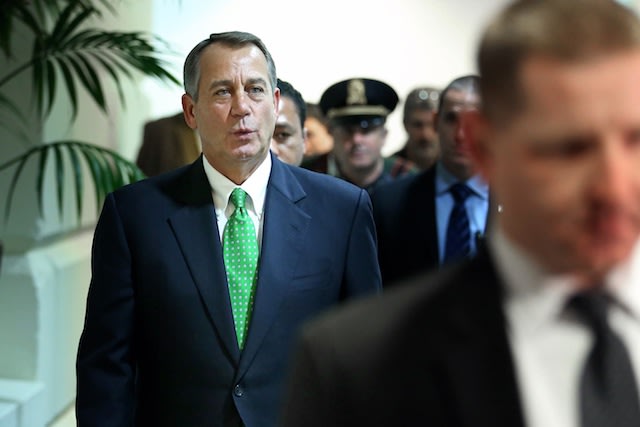
House Speaker John Boehner (Chip Somodevilla/Getty Images)

WASHINGTON Despite nine defections from fellow Republicans, Ohio Rep. John Boehner was re-elected as speaker of the House Thursday in a voice vote.

Boehner won the backing of 220 Republicans, who retained a majority in the chamber after November's election. But a handful of GOP members voted no or abstained. Most Democrats voted for House Minority Leader Nancy Pelosi.

Boehner's grasp on his speakership seemed tenuous going into the vote.

The Ohio congressman has come under fire from conservatives in recent weeks for supporting a "fiscal cliff" deal with President Barack Obama that allowed tax rates to increase. He allowed a vote on a package brokered by Senate Republican Leader Mitch McConnell and Vice President Joe Biden that most House Republicans opposed. The bill passed Tuesday with the support of Democrats.

Several northeastern Republicans loudly criticized Boehner for stalling a $60 billion relief bill for states hit by Superstorm Sandy. Boehner has pledged to hold a vote on Sandy relief on Friday.

Before the speakership vote, rumors swirled that enough conservative Republicans would vote against Boehner to force a second ballot some reporters took friendly bets on Boehner's future but they were unable to muster enough opposition to bring him down. Inside the House chamber Thursday, the defectors sat together in a clump near the center of the aisle during the vote and shouted several different nominees when their names were called.

Michigan Republican Rep. Justin Amash, still furious after Boehner revoked his committee assignment last year, voted for Idaho Rep. Raul Labrador instead.

Oklahoma Rep. Jim Bridenstine, New Mexico Rep. Steve Pearce and the newly elected Florida Rep. Ted Yoho voted for House Majority Leader Eric Cantor. (Cantor supported Boehner.)

Georgia Republican Rep. Paul Broun and Texas Rep. Louie Gohmert nominated former Rep. Allen West of Florida, prompting Democrats to respond with laughter on the other side of the aisle.

North Carolina Rep. Walker Jones voted for former U.S. Comptroller General David Walker, Kentucky Rep. Tom Massie voted for Amash, and Kansas Rep. Tim Huelskamp supported Rep. Jim Jordan of Ohio.

Republicans Labrador, Arizona Rep. Matt Salmon and South Carolina Rep. Mick Mulvaney did not vote, and Republican Rep. Steve Stockman of Texas voted present.

Once the votes were cast and Boehner was announced the winner, Republican and Democratic leaders joined the Ohio delegation in escorting Boehner to the speaker's chair, where he will serve for two more years.

In his first speech to the 113th Congress, Boehner urged members to remain true to the Constitution and focused his remarks on the national debt.

"Our government has built up too much debt. Our economy is not producing enough jobs. These are not separate problems," Boehner told the members in the chamber. "At $16 trillion and rising, our national debt is draining free enterprise and weakening the ship of state. "The American Dream is in peril so long as its namesake is weighed down by this anchor of debt. Break its hold, and we begin to set our economy free."

News startup BuzzFeed raises millions in new round


(Reuters) - News website BuzzFeed, one of the more interesting news business models to emerge in recent years, has raised $19.3 million in new capital, the company said on Thursday.

The round was led by venture capital firm NEA along with previous investors RRE, Hearst, SoftBank and Lerer Ventures. The founders of Buddy Media, Michael and Kass Lazerow, also participated.

The money will be used for mobile and video development, editorial hires and international expansion, the company said in a release.

BuzzFeed has skyrocketed in popularity and has caught the eye of media watchers for its innovative mix of news and advertising, including a mix of high- and low-brow content, photos driven by social media and sponsored stories.

The company said it has 40 million unique visitors a month. Editor-in-Chief Ben Smith runs an editorial team of 70.

BuzzFeed was started by Jonah Peretti, the co-founder of the Huffington Post, in 2006. It has raised $46 million in total.

(Reporting By Jennifer Saba in New York; Editing by Nick Zieminski)

NY pension fund sues Qualcomm for political records


(Reuters) - New York State's $150-billion public pension fund has sued Qualcomm Inc., seeking to force the chipmaker to reveal its political spending, according to the state comptroller.

The suit was filed late on Wednesday in Delaware Court of Chancery, after Qualcomm refused the request by the New York State Common Retirement Fund -- a Qualcomm shareholder -- to inspect records detailing the use of corporate resources for political activities, said state comptroller Thomas DiNapoli, who oversees the fund.

"Without disclosure, there is no way to know whether corporate funds are being used in ways that go against shareholder interests," DiNapoli, a Democrat who is up for re-election in 2014, said in a statement.

The suit opens a new front in the fight over corporate political spending, which has risen dramatically since the U.S. Supreme Court's 2010 ruling in Citizens United.

That decision lifted restrictions on corporate political spending and led in part to an unprecedented $6 billion of spending on the recently held U.S. elections.

While other companies have agreed to increase their disclosure of political spending, Qualcomm has not, the lawsuit said.

A spokeswoman for San Diego, California-based Qualcomm said the company had no immediate comment.

The New York State fund, the third-biggest public pension plan in the United States, owns more than 6.1 million Qualcomm shares, which are valued at about $396 million, based on Thursday's share price. The stake represents 0.36 percent of outstanding Qualcomm shares and makes the fund the company's 52nd largest shareholder, according to Thomson Reuters data.

New York is Qualcomm's largest U.S. public pension fund shareholder. The California Public Employees Retirement System, the largest U.S. pension fund with $241 billion in assets, owns about 4.3 million Qualcomm shares.

Since at least August 2012, the pension fund has repeatedly attempted to get the information from Qualcomm, but the company has refused to divulge it, the suit claimed.

New York's pension fund is "concerned that it cannot determine whether senior executives and directors of Qualcomm are spending corporate resources to support their favored political candidates" or on causes that aren't focused on boosting shareholder value, the complaint said.

Other sources show that in 2012, Qualcomm spent more than $4.7 million on federal lobbying efforts, according to the complaint.

The precise total is not known, DiNapoli told Reuters.

"Qualcomm has been particularly resistant in terms of disclosure," he said.

"The real question is we don't know what kind of spending they're doing," he said. "We have the right to have access to books to see where the spending is going."

In 2010, the fund and a group of other institutional investors asked most of the 500 biggest U.S. companies to disclose contributions.

Over the past two years, the group filed 27 related shareholder resolutions seeking more transparency, reaching deals with 10 companies, the comptroller said.

WITH NOVEL APPROACH, SUCCESS UNCERTAIN

The suit is believed to be the first in Delaware, where Qualcomm and most major U.S. companies are incorporated, to use the state's books-and-records law to compel political spending disclosures, a DiNapoli spokesman said.

As an institutional investor, the fund could attempt to remove directors from Qualcomm's board or sue board members if they were found to have wasted assets, the complaint said.

DiNapoli's office previously asked Qualcomm to provide documents that identified the date, recipient and amount of each political expenditure the company has made since January 21, 2010, as well as documents detailing the company's expenses for trade associations and other tax-exempt groups.

DiNapoli's office also asked for minutes of board meetings during which political causes or candidates were discussed.

The case would be tough to win if New York State claims that shareholders are entitled broadly to all documentation about political spending, according to Larry Hamermesh, a professor at Widener University School of Law in Wilmington, Delaware.

"I can't see a court saying that is correct any more than what a company spends on business in China are a legitimate subject for shareholder inspections," he said.

Hamermesh said investors might gain access if they take a targeted approach such as seeking contributions to specific races or contributions approved by the CEO.

Charles Elson, director of the Weinberg Center for Corporate Governance at the University of Delaware, said that if DiNapoli's legal team cannot point to evidence -- such as news reports that raised suspicions about the company's spending -- the lawsuit might not survive scrutiny by a judge who sees it as a fishing expedition,

But if it passes muster, the suit could become a model for other shareholders, Elson said.

DiNapoli's complaint said that studies indicate that corporate political spending is, in general, negatively correlated with enterprise value and can indicate widespread deficiencies in corporate governance.

Political donations can also backfire on corporations. For instance, Target Corp. in 2010 donated $150,000 to a political group that supported Minnesota gubernatorial candidate Tom Emmer, who opposed same-sex marriage. The contribution sparked backlash and led Target to later apologize, the suit noted.

(Reporting by Hilary Russ in New York and Tom Hals in Wilmington, Delaware; Additional reporting by Sinead Carew; Editing by Bernadette Baum, Leslie Adler and M.D. Golan)

Barnes & Noble sells fewer Nooks, retail revenue falls


(Reuters) - Barnes & Noble Inc's Nook unit reported weak holiday season numbers on Thursday as it sold fewer e-readers and tablets at its own stores, and its e-books sales growth slowed, raising questions about the future of its digital business.

The Nook, launched in 2009 to compete with Amazon.com Inc's market-leading Kindle, has been the cornerstone of Barnes & Noble's strategy to counter the shift by many book readers to digital books. Early growth attracted a big investment last year from Microsoft Corp.

And last week, British education and media publisher Pearson Plc said it would take a 5 percent stake in Barnes & Noble's Nook Media unit, which also includes its college bookstore chain, giving it a $1.8 billion value, about double the company's value as a whole.

But questions swirled about whether it is worth that much, after the retailer said that the Nook segment's revenue fell 12.6 percent from a year earlier during the nine weeks ended December 29, hurt by lower unit sales and prices.

Sales of digital content like e-books and magazines rose 13.1 percent during the holidays, a much slower pace than the 38 percent gain last quarter and 113 percent in the 2011 holiday season, suggesting Barnes & Noble is having trouble holding on to its 25-30 percent share of the U.S. e-books market.

"We are way beyond the point where you should see content sales accelerate," Morningstar analyst Peter Wahlstrom told Reuters. "That hasn't materialized and that's concerning."

The numbers were all the more disappointing given that in late November, Barnes & Noble had told investors Nook device sales doubled over the Black Friday weekend, which follows Thanksgiving and kicks off the holiday season in earnest.

That suggests the rest of season was a debacle, analysts said, and Chief Executive William Lynch said in a statement that Barnes & Noble is "examining the root cause" of the shortfall and will adjust its strategy.

"The investment question for Barnes & Noble in 2013 is the Nook's staying power as a legitimate tablet device," Credit Suisse analyst Gary Balter wrote in the note, predicting the retailer will face stiffer competition this year from the likes of Apple Inc and Google Inc, since tablets now have improved functions that make them more appealing to book readers.

The drop in Nook sales came despite the launch of two well-reviewed high-definition Nook tablets in October and promotions at large chains like Wal-Mart Stores Inc and Target Corp, both of which stopped selling Kindles last year.

Despite the holiday results, Barnes & Noble still expects Nook Media sales of $3 billion this fiscal year, keeping a forecast it gave in October.

That steady forecast helped lift shares 2.6 percent to $14.88 in morning trading.

The company will report full quarterly results in late February.

The results follow a warning from Barnes & Noble in a filing last week that holiday sales would come in below its expectations. The warning erased most of the gains in its share price that followed the news of Pearson's investment.

FEWER VISITORS IN STORES

Compounding Barnes & Noble's troubles, fewer shoppers came into its bookstores during the Christmas period.

Barnes & Noble, which had enjoyed a sales bump after onetime rival Borders Group liquidated in 2011, reported a 10.9 percent decrease in sales at its bookstores and on its website over the holiday period.

Sales at stores open at least 15 months fell 3.1 percent, excluding Nook products, despite the benefit of some store closings -- Barnes & Noble operates 689 bookstores, 14 fewer than a year ago.

"The Borders tailwind is over," Morningstar's Wahlstrom said.

(Reporting by Phil Wahba in New York; editing by John Wallace and Nick Zieminski)

Twin mothers in Ohio give birth the same day


AKRON, Ohio (AP) Aiden and Donavyn didn't wait until New Year's Day to come screaming into the world, but the circumstances of their births are still pretty special: The babies were born about two hours apart to Ohio mothers who are identical twins.

The Akron Beacon Journal (http://bit.ly/YQpn3X ) reports that the 19-year-old mothers Aimee and Ashlee Nelson weren't raised to do things alike and did not plan the births to come at the same time. In fact, their due dates were about a week apart.

Aimee's son, Donavyn Scott Bratten, was born just after noon on the last day of 2012. Ashlee's son, Aiden Lee Alan Dilts, made his appearance at about 2 p.m.

They were delivered by the same doctor at Summa Akron City Hospital.

___

Information from: Akron Beacon Journal, http://www.ohio.com

Gunn expands his mentoring 'Baileywick' to Disney


NEW YORK (AP) Tim Gunn has advised divas for years on "Project Runway," so working with a princess is no big deal.

In the new Disney Junior animated series "Sofia the First," Gunn's royal steward character, Baileywick, helps the young Sofia adapt to royal life after her mother marries a king. Baileywick not only helps Sofia (voiced by Ariel Winters) dress like a royal, but he also guides her on developing manners, grace and an independent spirit.

"I feel very comfortable in this role," he says.

Certainly, 2- to 7-year-old children are a new audience, Gunn says, but being a teacher who knows when to give congratulations and critiques and how to look after his charge are skills he's honed for most of his professional life. Before Heidi Klum came calling for him to work on TV with aspiring designers, Gunn was chair of Parsons The New School for Design fashion department.

Gunn, 59, says he enjoys sometimes veering from the expected career path. A few years ago, Marvel Comics turned him into a superhero to save a fashion exhibit.

"When Marvel asked if I would do it, they asked with trepidation. They were nervous that I wouldn't, but who doesn't want to be their own comic book superhero?" Gunn says. "I said I'd do it in a heartbeat, and it was the same way with Disney."

Disney launched the characters in a TV movie just before Thanksgiving. It attracted an audience of 5.2 million viewers. The regular series debuts Jan. 11.

The message of "Sofia the First" is a good one, Gunn says: Looking the part only gets you halfway there and then you have to act like a leader and be nice to people at the same time. "If I had a child, I would want my child watching this for the lesson in moral character."

It might be harder for kids or the parents watching with them to glean any real-life style tips.

"I'm dealing with royalty here," says Gunn. "They can make their own fashion rules."

___

Online:

http://disney.go.com/disneyjunior/sofia-the-first

___

Samantha Critchell tweets fashion at http://www.twitter.com/AP_Fashion and can be reached at http://www.twitter.com/Sam_Critchell

Sandy Hook students, parents prepare for emotional return to school


A sign welcoming Sandy Hook students is displayed across the street from Chalk Hill School. (Dylan Stableford/Yahoo!

MONROE, Conn. Sandy Hook Elementary School teachers, students and parents are preparing for an emotional return to school on Thursday at a repurposed facility here, less than a month after a gunman killed 20 children and six adults including principal Dawn Hochsprung at their school in Newtown, Conn.

On Wednesday, a day before classes are set to resume, students and parents are scheduled to attend an open house at Chalk Hill School, a former middle school that workers have prepared to house the Sandy Hook children. School officials say they have tried to completely re-create classrooms in an effort to make students as comfortable as possible.

Parents are being encouraged to attend school with their children on Thursday.

"I want to reassure you that we understand many parents may need to be near their children on their first day(s) of school and you will be welcome," interim principal Donna Page wrote in a letter to parents. "That being said, we encourage students to take the bus to school in order to help them return to familiar routines as soon as possible. Parents choosing to join their children may come to school after our 9:07 a.m. opening and will be welcome in the classroom or the auditorium throughout the day."

To "ensure a safe and secure environment," Page continued, "we ask that no more than one adult family member accompany his/her child."

[Related: Scenes from Newtown, Connecticut]

Some of the therapy dogs that have blanketed Newtown in the wake of the shootings will also be present at the school to comfort the children. Ten golden retrievers from Chicago's Lutheran Church Charities, which were sent to Newtown to comfort survivors last month, traveled back to Newtown on New Year's Day to prepare for the school's reopening.

Other public schools in Newtown reopened within a week of the shootings, but Sandy Hook Elementary has remained closed since Dec. 14, when 20-year-old gunman Adam Lanza shot his way into the school and opened fire before turning a gun on himself. Lanza also killed his mother in their Newtown home before going on the rampage, one of the deadliest in U.S. history.

"I want parents and families enduring the loss of their precious children to know their loved ones are foremost in our hearts and minds as we move forward," Page also wrote. "We recognize your needs are paramount in our preparations and planning. Your strength and compassion has been and will continue to be an inspiration to me and countless others as we work to honor the memory of your precious children and our beloved staff."

Pop star Rain in trouble over paparazzi photos


SEOUL, South Korea (AP) South Korean pop star Rain is facing questions after paparazzi photos showed him out on the town with a top actress.

Seoul's Defense Ministry said Wednesday it is investigating whether Rain broke military rules by meeting actress Kim Tae-hee while on duty.

Rain is fulfilling his compulsory army service as an entertainer for the military. He is not allowed to have private meetings while outside his Seoul base for official duties such as recording and performing.

The ministry says a brief lockup in a military jail cannot be ruled out as a penalty.

Kim's agency admits that the two have dated for a month. Rain's agency neither denies nor confirms it.

Rain joined the military in October 2011 and is scheduled to be discharged in July.

Thousands line route of Pasadena's Rose Parade


PASADENA, Calif. (AP) Thousands of people in Southern California are lining the route of the 124th Rose Parade in Pasadena.

The die-hards staked out their spots early Monday with folding chairs, hammocks and portable barbeque grills. They brought in the new year by throwing marshmallows, shaving cream and tortillas, and then hunkered down to stay warm in sleeping bags.

The parade features floats covered with flowers and plant material and marching bands from across the country. It will be broadcasts around the world.

College student Brandy Grueter (GROO'-ter) spent the night on the sidewalk with her younger brother and saved spots for about 20 friends and family. She says she slept 20 minutes but would rally enough energy once the parade started.

The pre-dawn line at a Starbuck's stretched around the block.

Governor plans to sue NCAA over Penn St. sanctions


HARRISBURG, Pa. (AP) Gov. Tom Corbett scheduled a news conference for Wednesday to announce the filing of a federal lawsuit against the NCAA over stiff sanctions imposed against Penn State in the aftermath of the Jerry Sandusky child sex abuse scandal.

The news conference announcing the filing in U.S. District Court in Harrisburg was set to be held at the university's State College campus.

A person associated with the university and knowledgeable about the matter told The Associated Press that it is an antitrust action. The person spoke on condition of anonymity because the lawsuit hasn't been filed.

The university agreed in July to the sanctions, which included a $60 million fine that would be used nationally to finance child abuse prevention grants. The sanctions also included a four-year bowl game ban for the university's marquee football program, reduced football scholarships and the forfeiture of 112 wins but didn't include a suspension of the football program, the so-called death penalty.

In announcing the news conference, Corbett, a Republican, did not indicate whether his office coordinated its legal strategy with state Attorney General-elect Kathleen Kane, who is scheduled to be sworn in Jan. 15.

Kane, a Democrat, ran on a vow to investigate why it took state prosecutors nearly three years to charge Sandusky, an assistant under legendary football coach Joe Paterno. Corbett was the attorney general when that office took over the case in early 2009 and until he became governor in January 2011.

State and congressional lawmakers from Pennsylvania have objected to using the Penn State fine to finance activities in other states. Penn State has already made the first $12 million payment, and an NCAA task force is deciding how it should be spent.

The NCAA, which declined to comment Tuesday on the planned lawsuit, has said at least a quarter of the money would be spent in Pennsylvania.

Republican U.S. Rep. Charlie Dent called that an "unacceptable and unsatisfactory" response by the NCAA to a request from the state's U.S. House delegation that the whole $60 million be distributed to causes within the state.

Last week, state Sen. Jake Corman, a Republican whose district includes Penn State's main campus, said he plans to seek court action barring any of the first $12 million from being released to groups outside the state.

Sandusky, 68, was convicted in June on charges he sexually abused 10 boys, some on Penn State's campus. He's serving a 30- to 60-year state prison term.

Eight young men testified against him, describing a range of abuse they said went from grooming and manipulation to fondling, oral sex and anal rape when they were boys.

Sandusky did not testify at his trial but has maintained his innocence, acknowledging he showered with boys but insisting he never molested them.

Chavez's VP says ailing leader still 'delicate'


CARACAS, Venezuela (AP) Venezuela's vice president is returning home Wednesday from a visit with Hugo Chavez in Cuba and says the ailing president's condition remains "delicate" three weeks after his cancer surgery.

With rumors swirling that Chavez had taken a turn for the worse, Vice President Nicolas Maduro said Tuesday that he had met with the president twice and had spoken with him.

"He's totally conscious of the complexity of his post-operative state and he expressly asked us ... to keep the nation informed always, always with the truth, as hard as it may be in certain circumstances," Maduro said in the prerecorded interview in Havana, which was broadcast Tuesday night by the Caracas-based television network Telesur.

Both supporters and opponents of Chavez have been on edge in the past week amid shifting signals from the government about the president's health. Chavez has not been seen or heard from since the Dec. 11 operation, and officials have reported a series of ups and downs in his recovery the most recent, on Sunday, announcing that he faced new complications from a respiratory infection.

Maduro did not provide any new details about Chavez's complications during Tuesday's interview. But he joined other Chavez allies in urging Venezuelans to ignore gossip, saying rumors were being spread due to "the hatred of the enemies of Venezuela."

He didn't refer to any rumors in particular, though one of them circulating online had described Chavez as being in a coma.

Maduro said Chavez faces "a complex and delicate situation." But Maduro also said that when he talked with the president and looked at his face, he seemed to have "the same strength as always."

"All the time we've been hoping for his positive evolution. Sometimes he has had light improvements, sometimes stationary situations," he said.

Maduro's remarks about the president came at the end of an interview in which he praised Venezuelan government programs at length, recalled the history of the Cuban revolution and touched on what he called the long-term strength of Chavez's socialist Bolivarian Revolution movement.

He mentioned that former Cuban President Fidel Castro had been in the hospital, and praised Cuba's government effusively. "Today we're together on a single path," Maduro said.

Critics in Venezuela sounded off on Twitter while the interview was aired, some saying Maduro sounded like a mouthpiece for the Cuban government. In their messages, many Chavez opponents criticized Maduro for the dearth of information he provided, accusing him of withholding key details about Chavez's condition.

Chavez's political opponents have complained that the government hasn't told the country nearly enough about his health, and have demanded it provide the country with a full medical report.

Even some of his supporters say they wished they knew more.

"We're distressed by El Comandante's health," said Francisca Fuentes, who was walking through a downtown square with her grandchildren Tuesday. "I think they aren't telling us the whole truth. It's time for them to speak clearly. It's like when you have a sick relative and the doctor lies to you every once in a while."

Chavez has been fighting an undisclosed type of pelvic cancer since June 2011. He has declined to reveal the precise location of the tumors that have been surgically removed. The president announced on Dec. 8, two month after winning re-election, that his cancer had come back despite previous surgeries, chemotherapy and radiation treatment.

"There's nothing we can do except wait for the government to deign to say how he is really," said Daniel Jimenez, an opposition supporter who was in a square in an affluent Caracas neighborhood.

Jimenez and many other Venezuelans say it seems increasingly unlikely that Chavez can be sworn in as scheduled Jan. 10 for his new term. If he dies or is unable to continue in office, the Venezuelan Constitution says a new election should be held within 30 days.

Before his operation, Chavez acknowledged he faced risks and designated Maduro as his successor, telling supporters they should vote for the vice president if a new presidential election was necessary.

Maduro didn't discuss the upcoming inauguration plans, saying only that he is hopeful Chavez will improve.

The vice president said that Chavez "has faced an illness with courage and dignity, and he's there fighting, fighting."

"Someone asked me yesterday by text message: How is the president? And I said, 'With giant strength,'" Maduro said. He recalled taking Chavez by the hand: "He squeezed me with gigantic strength as we talked."

___

Associated Press writer Jorge Rueda contributed to this report.

___

Ian James on Twitter: http://twitter.com/ianjamesap

DiDonato a luminous Mary Stuart at Met


NEW YORK (AP) The Metropolitan Opera may have pretty much turned opening night over to the glamorous Anna Netrebko, but New Year's Eve belongs to a very different diva Joyce DiDonato.

Last year the Kansas-born mezzo-soprano headlined a starry lineup in the baroque pastiche "The Enchanted Island." On Monday night she brought a gala audience to its feet with a luminous performance in the title role of Donizetti's "Maria Stuarda."

Never before performed at the Met, this second opera in the composer's so-called "Three Queens" trilogy portrays the lethal conflict between Mary, deposed queen of Scotland, and Queen Elizabeth I of England.

From the moment she makes her entrance in the second scene, singing of her joy in strolling outside her prison in Fotheringay Castle, DiDonato rivets attention. She imbues every syllable with a concentrated eloquence that makes her compact voice seem larger than it is. She displays seemingly effortless command of coloratura embellishments throughout a wide vocal range. And she is equally impressive in fiery outbursts and in hushed, long-held phrases like the ones she spun out as she sang through the chorus in the final scene.

The opera's dramatic heart is a confrontation between the two queens that never took place in history but that figures in the Friedrich Schiller play on which the libretto is based. Mary at first abases herself in hope of winning a pardon; then, as Elizabeth hurls insults, her pride reasserts itself and she seals her doom by denouncing her rival as "figlia impura di Bolena" ("impure daughter of Anne Boleyn") and "vil bastarda" ("vile bastard").

DiDonato was impressive in this scene when she sang the role for the first time last spring in Houston, but her performance Monday night was even better more confident and more filled with vocal and dramatic shadings. There was a wonderful touch when, after she had spent her fury, she allowed herself a beatific smile, as if to convey: "There! I said it and I'm glad!"

Of course, it takes two to stage a confrontation, and DiDonato's partner at the Met is Elza van den Heever, a South African soprano making her debut. She has a voice that's impressive in many respects, with a large and vibrant upper register. But she tended to fade out in the lower part of her range, where much of Elizabeth's music lies.

More damagingly, she was victimized by a quirk of David McVicar's production that has Elizabeth lurching awkwardly about the stage for much of the evening, as if thrown off balance by John Macfarlane's elaborate period costumes. Perhaps this bizarre gait is intended to contrast with Mary's immaculate poise, but it mainly proves distracting.

The opening scene in Elizabeth's palace is garishly staged, with what look like red rafters hanging down from the ceiling and gratuitous acrobats in devil costumes, but once past this, matters improve. For the scene outside Fotheringay, Macfarlane fills the stage with spindly trees barren of leaves and provides a painted backdrop that evokes a cloudy landscape. The final tableau is also striking: Mary, shorn of her long hair and wearing a simple red dress, climbs a staircase with her back to the audience to meet her executioner and the chopping block.

Though the two queens dominate the opera, there are some other characters, and they are all in extremely good hands. Having the elegant tenor Matthew Polenzani take on the thankless role of the ineffectual Leicester is luxury casting indeed. Bass Matthew Rose is warmly sympathetic as Mary's confessor, Talbot; baritone Joshua Hopkins sings with robust tone as her nemesis, Cecil; and mezzo Maria Zifchak lends her customary strong support as Mary's attendant, Anna.

Maurizio Benini conducts a lithe and lively performance of the score, even if he can't quite disguise the fact that the second half of the opera is decidedly anti-climactic.

There are seven more performances, including a matinee on Saturday, Jan. 19, that will be broadcast live in HD to movie theaters around the world.

Asia stocks at five-month high as U.S. fiscal cliff crisis ends


HONG KONG (Reuters) - Asian stocks hit a five-month high and the dollar fell as a last-minute deal ended the U.S. "fiscal cliff" crisis that threatened a U.S. recession and roiled world financial markets.

The U.S. Congress approved extending lower Bush-era tax rates to all but the nation's wealthiest households in a budget deal that stops automatic implementation of $600 billion in spending cuts and tax increases.

The bill's passage in Congress allayed earlier concerns over complaints from a number of Republicans that spending cuts were still not adequately addressed.

The temporary reprieve that the deal offers the U.S. economy also sets up Wall Street for a strong start to trading which resumes later in the day.

Asian stock markets cheered the developments as a major risk for investors, namely a slump in global growth, appeared to have receded for now.

The MSCI Asia Pacific ex-Japan index of stocks jumped 1.8 percent. Chinese shares in Hong Kong jumped 3 percent as last month's rally spilled over into the new year.

"If the fog caused by the fiscal cliff disappears, there will probably be moves toward putting risk back on," said Satoshi Okagawa, senior global markets analyst for Sumitomo Mitsui Banking Corporation in Singapore.

In South Korea, where data showed manufacturing activity rose for the first time in seven months in December, the KOSPI index was up 1.6 percent while Australian shares rose to their highest level in 19 months.

Asian stocks outside Japan rose nearly 20 percent last year as a combination of improving economic data from China, easing worries about a euro zone blow-up, and global central bank easing that encouraged investors back into equity markets.

Sakthi Siva, Asia strategist for Credit Suisse, said in a note to clients that 2013 could see similar returns for Asian equities, given a solution to the fiscal crisis.

"As we move into 2013 we retain our bullish bias, and our theme is whether markets could catch up with earnings," said Siva, adding that markets in China and India could offer the most upside given the mismatch between index levels and earnings expectations.

OIL, EURO UP

Risky assets across the board got a lift with crude oil futures up 0.9 percent and copper futures in London jumping 1.7 percent.

The euro rose to $1.3261 against the U.S. dollar.

The safe-haven U.S. dollar edged lower, falling 0.4 percent against a basket of major currencies .

The Australian dollar, a currency that tends to benefit when optimism about the outlook for the global economy increases, rose to $1.0470.

The Japanese yen continued its slide as investors wagered the Bank of Japan would have to take ever-more aggressive easing steps to support the economy and satisfy the new government.

The yen fell to 87.17 against the dollar to its weakest level since July 2010.

The Japanese currency also dropped to depths not seen in more than four years against the Australian and New Zealand dollars.

(Additional reporting by Wayne Cole in SYDNEY and Masayuki Kitano in SINGAPORE; Editing by Eric Meijer)

Asia stocks at five-month high as fiscal cliff crisis ends


HONG KONG (Reuters) - Asian stocks hit a five-month high and the dollar fell as a last-minute deal ended the U.S. "fiscal cliff" crisis that threatened a U.S. recession and roiled world financial markets.

The U.S. Congress approved a rare tax increase on Tuesday that will hit the nation's wealthiest households in a bipartisan budget deal that stops the world's largest economy from falling into recession.

Early on Tuesday the U.S. Senate passed a bill that aims to avoid the cliff's automatic implementation of $600 billion in spending cuts and tax increases.

The bill's passage in Congress allayed earlier concerns over complaints from a number of Republicans that spending cuts were still not adequately addressed.

Asian stock markets cheered the developments as a major risk for investors, namely a slump in global growth, appeared to have receded for now.

The MSCI Asia Pacific ex-Japan index of stocks jumped 1.7 percent. Chinese shares in Hong Kong jumped 2.9 percent as last month's rally spilled over into the new year.

"If the fog caused by the fiscal cliff disappears, there will probably be moves toward putting risk back on," said Satoshi Okagawa, senior global markets analyst for Sumitomo Mitsui Banking Corporation in Singapore.

In South Korea, where data showed manufacturing activity rose for the first time in seven months in December, the KOSPI index was up 1.5 percent.

Asian stocks outside Japan rose nearly 20 percent last year as a combination of improving economic data from China, easing worries about a euro zone blow-up, and global central bank easing that encouraged investors back into equity markets.

Sakthi Siva, Asia strategist for Credit Suisse, said in a note to clients that 2013 could see similar returns for Asian equities, given a solution to the fiscal crisis.

"As we move into 2013 we retain our bullish bias, and our theme is whether markets could catch up with earnings," said Siva, adding that markets in China and India could offer the most upside given the mismatch between index levels and earnings expectations.

OIL, EURO UP

Risky assets across the board got a lift with crude oil futures up 0.8 percent and copper futures in London jumping 1.7 percent.

The euro rose to $1.3267 against the U.S. dollar.

The safe-haven U.S. dollar edged lower, falling 0.4 percent against a basket of major currencies .

The Australian dollar, a currency that tends to benefit when optimism about the outlook for the global economy increases, rose to $1.0470.

The Japanese yen continued its slide as investors wagered the Bank of Japan would have to take ever-more aggressive easing steps to support the economy and satisfy the new government.

The yen fell to 87.17 against the dollar to its weakest level since July 2010.

The Japanese currency also dropped to depths not seen in more than four years against the Australian and New Zealand dollars.

(Additional reporting by Wayne Cole in SYDNEY and Masayuki Kitano in SINGAPORE; Editing by Eric Meijer)

LG Elec starts taking pre-orders for OLED TVs for Feb delivery


SEOUL (Reuters) - LG Electronics Inc started taking orders on Wednesday for organic light-emitting diode (OLED) televisions, hoping to take the initiative over its rival Samsung in the next-generation technology.

LG and Samsung showcased 55-inch OLED TVs a year ago but, priced five times higher than liquid-crystal display (LCD) equivalents, they have yet to reach store shelves.

The technology is considered the future of consumer electronics displays and promises to change the way people use TVs, computers, tablets and smartphones.

OLED is more energy efficient and offers higher contrast images than LCD. It is so thin that future mobile devices will be unbreakable and will be able to be folded or rolled like paper.

LG, the world's No.2 TV manufacturer, said it would start delivery of the new TVs from early February, with plans to display them at 1,400 retail outlets in South Korea.

They would be launched in the U.S., Europe and other Asian markets during the first quarter of 2013.

The 55-inch model would sell for 1.1 million won ($1,000)-- nearly four times that of LG's LED-backlit LCD model and around five times that of more common LCD versions.

OLED displays are already used on Samsung's popular Galaxy S and Note smartphones.

But OLED panel makers such as LG Display and Samsung Display have yet to address manufacturing challenges to lower costs to compete against LCD panels. ($1 = 1070.5750 Korean won) (Reporting by Miyoung Kim; Editing by Stephen Coates and Paul Tait)

Hundreds ring in 2013 with icy plunge in NY waters


NEW YORK (AP) Hundreds of hardy swimmers rang in 2013 with a plunge into the icy sea off Brooklyn's Coney Island, an area struggling to recover from Superstorm Sandy.

Members of the Ice Breakers and the Coney Island Polar Bear clubs and other brave bathers stripped down to their trunks or dressed in costumes for the annual New Year's Day splash.

Some people hit the surf dressed only in bikinis or briefs. One woman dressed as a mermaid. Another swimmer wore a hat with horns. Temperatures outside were in the 30s, and people screamed at the shock of the cold water.

This year, Polar Bear club members and others were raising money for Sandy relief efforts. The area was badly flooded by the late October storm.

The Ice Breakers try to raise awareness of water pollution.

One of 9 deceased victims of Oregon bus crash identified so far


PORTLAND, Oregon (Reuters) - Oregon authorities said on Tuesday they have managed to positively identify one of nine people killed Sunday morning after a charter bus skidded off an icy mountain highway and crashed down an embankment.

Identification of the victims has been complicated because some were foreign nationals, said Eugene Gray, forensic administrator for the Oregon State Medical Examiner's Office.

The Korean Consulate in Seattle, Wash. sent a team to work with investigators, since many of the 47 people on the bus were of Korean origin and citizens of Korea.

Some other passengers were Canadian and others were from the United States.

"We do positive identifications with fingerprints, dental records and DNA," Gray told Reuters. "None of this is available to us. We don't know how long it will take. We have to wait until we're provided the information."

The lone identification provided by authorities so far is that of Dale William Osborn, 57, from Spanaway, Washington, who was killed in the crash, officials said in a press release Tuesday.

His wife, 65 year-old Darlene Sue Osborn, was being treated at St. Anthony Hospital, Pendleton.

The Oregon State Police said on Tuesday that one of the people killed in the crash may be a juvenile female. Of the nine people killed, four are male and five are female.

The tour bus veered off an icy highway on Sunday morning, crashed through a guardrail and plunged 200 feet down an embankment, killing nine and injuring most of the other 38 people on board.

The injured were taken to 10 hospitals in three states and at least nine remained hospitalized on Tuesday.

Of the 26 people transported to St. Anthony Hospital in Pendleton, Oregon, five of the most severely injured were stabilized and transported to hospitals better equipped to treat them.

Tuesday, St. Anthony had five patients remaining, all in fair condition, said Larry Blanc, director of communications.

Four of the patients transferred to Oregon Health & Science University Hospital in Portland remained there on Tuesday, a spokeswoman said.

Oregon State Police and the National Transportation Safety Board are combing through evidence and interviewing passengers and the driver to try to determine the cause of the crash.

(Editing by Dan Whitcomb and David Gregorio)

California newspaper defies trend to shrink costs


SANTA ANA, Calif. (AP) New and expanded sections to cover business, automobiles and food. A nearly five-fold increase in community news pages and more investigative reporting. Even daily color comics.

It feels like a throwback to an earlier era at the Orange County Register, where a first-time newspaper owner is defying conventional wisdom by spending heavily to expand the printed edition and playing down digital formats.

Aaron Kushner added about 75 journalists and, with 25 more coming, will have expanded the newsroom by half since his investment group bought the nation's 20th-largest newspaper by circulation in July.

Changes also include thicker pages with triple the number of colors to produce razor-sharp photos and graphics. By the end of March, the newspaper will have 40 percent more space than under previous owners, Freedom Communications Inc.

Kushner, 39, believes people will pay for high-quality news. His bet is remarkable in an industry where newspapers have shrunk their way to profits for years, slashing costs while seeking clicks on often-free websites to attract online advertising.

As more newspapers begin charging for online access, Kushner's spending spree is drawing close attention.

"If he's successful, it's going to show the way for other papers to follow," said Walter E. Hussman Jr., publisher of the Arkansas Democrat-Gazette and an early advocate of charging readers for online access.

Seated behind his large, clutter-free desk near shelves stacked with newspapers, the former Stanford University gymnast said his lack of industry experience may be a plus because he hasn't been through the tough times in newspapering.

"So when we sit down and look at what's possible, our view of the world is different," Kushner said. "We're a little crazy in that we really do believe that we can grow this particular newspaper."

It's too early to know whether he's right. Kushner said advertising revenues have grown, though he won't say how much.

Average daily circulation rose 5.3 percent as of Sept. 30 from a year earlier to 285,088 on weekdays and 387,547 on Sundays, bucking an industry decline of 0.2 percent, according to the Alliance for Audited Media.

One key test will be when the Register begins charging for online access sometime before the end of March. He said readers will pay the same as the print edition a contrast to publications that charge online subscribers substantially less.

"If you have a wonderful restaurant and it cost $10 to come in the front door, I've never understood why it should cost anything less to come through a side door," he said.

"The value of the journalism isn't any less. The reporter isn't paid any less. The photographer isn't paid any less."

Kushner, who has a master's degree in organizational analysis, founded a business in the 1990s that allowed people to change their addresses online and later owned and managed a greeting-card company for seven years.

In 2010, he started an investors group, 2100 Trust LLC, to scout for newspapers, flirting with The Boston Globe and later with MaineToday Media Inc., publisher of The Portland Press Herald.

Tom Bell, president of The Portland Newspaper Guild, said Kushner presented the union with 50 demands, including a longer work week and increases in employee health care contributions.

"We got off to such a bad start that it was hard to recover," said Bell, who is skeptical of that Kushner's print bet will succeed.

Kushner settled on Freedom and its 107-year-old flagship paper, the Register, for an undisclosed sum. The newspaper serves affluent, growing, well-educated and ethnically diverse communities near Los Angeles, bolstered by 24 community publications.

Kushner became Freedom's chief executive and the Register's publisher, working five days a week at the company's Santa Ana headquarters and flying cross-country to his wife and three children in the Boston area.

Many executives stayed put, including the top editor, Ken Brusic, who joined the Register in 1989.

The newsroom is nearing 300 employees, including about 40 year-round interns who are paid $10 an hour and provided housing. The new owners eliminated 401(k) matches at the non-union newspaper and have resisted pay raises.

Like other newspapers, the Register experimented over the last decade as its circulation tumbled 40 percent and the newsroom shrank in half. A tabloid paper featuring snappier stories failed, as did a weekly entertainment publication.

Reporters got ever-rising numerical targets to generate Web traffic, with constant reminders of how they fared against peers. "It was more like a sales floor than a newsroom," columnist Frank Mickadeit wrote in a recent piece hailing the Register's "reawakening."

To focus more on the print edition, the Register slashed the number of blogs from around 40 to less than a dozen. It scrapped an iPad application for news, traffic and weather.

The new owners have introduced a daily page for coverage of a major development, began sending a reporter and photographer to every one of the region's 50 high school football games on Fridays and doubled editorial pages.

Reporters have been encouraged to dig deeper and expand sources. "It's a new experience for (a publisher) to say, 'Are you sure you have enough investigative reporters? I think you ought to hire more,'" Brusic said.

The Register's editorial page once a strong libertarian voice didn't endorse for president in November. Kushner has contributed to Democrats such as Barack Obama and Joe Biden and moderate Republicans, including Sen. Susan Collins of Maine.

Kushner declined to discuss his political views and said they are separate from his work at the Register.

He is looking to buy more newspapers, telling Register staff last year that he had a list of 15 that fit his criteria. In an interview, he expressed interest in Tribune Co. newspapers, which include the Chicago Tribune, Los Angeles Times and Baltimore Sun.

Some readers and employees question how much the new owners will stomach if growth stalls. Kushner insisted he is committed, saying the Register has a strong balance sheet and doesn't answer to shareholders seeking quick returns.

"If you don't have a clear tangible way to grow revenue you only have one alternative and that's to cut costs," he said. "That path may well work. That's not the path that we're on here."

Pasadena's Rose Parade kicks off on a cold morning


PASADENA, Calif. (AP) The 124th Rose Parade in Pasadena kicked off on a chilly New Year's morning with the theme "Oh the Places You'll Go!" named in honor of the Dr. Seuss book.

Led by this year's grand marshal, British primatologist Jane Goodall, the parade features 42 floats covered with flowers and plant material, 23 marching bands and 21 equestrian units from across the country.

An estimated 700,000 spectators are lining the streets to view the 5-mile-long spectacle, which is broadcast around the world. This year's parade features the first-ever float entered by the Defense Department and a couple getting married on a float.

The $247,000 military float is a replica of the Korean War Veterans Memorial in Washington to commemorate the veterans from that conflict.

The float that scooped up the parade's grand "Sweepstakes" prize for the most beautiful floral presentation and design was "Dreaming in Paradise" by fruit and vegetable producer Dole.

Die-hard parade fans staked out their spots early Monday with folding chairs, hammocks and portable barbeque grills.

They brought in the new year by throwing marshmallows, shaving cream and tortillas, and then hunkered down to stay warm in sleeping bags during a particularly cold night for Southern California.

The wave of under-40-degree temperature spurred a number of cold-weather exposure calls to emergency personnel, police department spokeswoman Lisa Derderian told City News Service.

As of 8 a.m. Tuesday, police had made a total of 22 arrests along the parade route since 6 p.m. Monday, said police Lt. Rick Aversan.

All but one arrest were for public intoxication. The other was for possession of burglary tools that could have been used to break into cars, police said.

Concern over Oscar voting extends deadline


LOS ANGELES (AP) Growing concern that problems with the new electronic Oscar voting system could lead to record-low turnout has prompted the motion picture academy to extend the deadline for members to vote for Oscar nominations.

But next week's highly anticipated announcements looming, the extension is only for a day, until Friday. The Academy of Motion Picture Arts and Sciences said Monday any votes received after the new deadline will not be counted.

"By extending the voting deadline we are providing every opportunity available to make the transition to online balloting as smooth as possible," said the academy's chief operating officer, Ric Robertson, in a statement. "We're grateful to our global membership for joining us in this process."

Reports of difficulty accessing the Oscars' first-ever online voting system and fears that it could be hacked have raised questions about balloting for the 85th annual contest. Earlier this year, the academy and its longtime accountants, PricewaterhouseCoopers, partnered with the electronic voting firm Everyone Counts Inc. to develop the system.

"There's considerable concern from many members that voter participation will be at record lows this year because the people who wanted to take a chance on this new cutting-edge system are either giving up on it or worried they won't be able to cast their votes," said Scott Feinberg, awards analyst and blogger for The Hollywood Reporter.

In the past, Oscar voting has been compiled strictly through paper ballots sent through the mail. The new system allows members to choose between voting online or sticking with a traditional mail-in ballot.

Morgan Spurlock, the documentary filmmaker whose 2004 film "Super Size Me" was nominated for best documentary, posted on Twitter last week that he wasn't able to log on to vote electronically and his ballot was instead mailed to him.

"The password they sent didn't work for my log-in and they couldn't email me a new log-in, only snail mail," tweeted the 42-year-old director.

The academy said it has made several voting resources available to members, including assisted voting stations in Los Angeles, New York and London, and a 24-hour support line.

A spokesman for Everyone Counts didn't immediately respond to a request seeking comment.

Besides online voting, a retooled nomination period could also affect the competition.

Organizers moved up the unveiling of the Oscar nominations to Jan. 10. That change puts the announcement three days before Hollywood's second-biggest awards ceremony, the Hollywood Foreign Press Association's Golden Globes, which are scheduled for Jan. 13.

Oscar overseers originally said the switcheroo would give the academy's nearly 6,000 members more time to see nominated films before the Feb. 24 awards ceremony, but Feinberg of The Hollywood Reporter noted that the change gave voters less time to see potential contenders during the first phase of voting, when members decide on nominees.

"If the turnout is lower among older members, more traditional Oscar contenders will probably receive fewer votes, and otherwise edgier films that appeal more to younger people could fare better," said Feinberg. "Because of the way that best-picture voting works, it could increase the chances of a movie like 'The Master' or 'Moonrise Kingdom' getting in."

Ultimately, because of the inherent secrecy involved in selecting Oscar winners, Feinberg said it will be impossible to know what affects if any this year's voting changes have on the ceremony, where as many as 10 films could be vying for the best-picture award.

___

Online:

http://www.oscars.org

___

Follow AP Entertainment Writer Derrik J. Lang on Twitter at http://www.twitter.com/derrikjlang.

Clinton receiving blood thinners to dissolve clot


WASHINGTON (AP) Doctors treating Secretary of State Hillary Rodham Clinton for a blood clot in her head said blood thinners are being used to dissolve the clot and they are confident she will make a full recovery.

Clinton didn't suffer a stroke or neurological damage from the clot that formed after she suffered a concussion during a fainting spell at her home in early December, doctors said in a statement Monday.

Clinton, 65, was admitted to New York-Presbyterian Hospital on Sunday when the clot turned up on a follow-up exam on the concussion, Clinton spokesman Phillipe Reines said.

The clot is located in the vein in the space between the brain and the skull behind the right ear. She will be released once the medication dose for the blood thinners has been established, the doctors said.

In their statement, Dr. Lisa Bardack of the Mount Kisco Medical Group and Dr. Gigi El-Bayoumi of George Washington University said Clinton was making excellent progress and was in good spirits.

Clinton's complication "certainly isn't the most common thing to happen after a concussion" and is one of the few types of blood clots in the skull or head that are treated with blood thinners, said Dr. Larry Goldstein, a neurologist who is director of Duke University's stroke center. He is not involved in Clinton's care.

The area where Clinton's clot developed is "a drainage channel, the equivalent of a big vein inside the skull. It's how the blood gets back to the heart," Goldstein said.

Blood thinners usually are enough to treat the clot and it should have no long-term consequences if her doctors are saying she has suffered no neurological damage from it, Goldstein said.

Clinton returned to the U.S. from a trip to Europe, then fell ill with a stomach virus in early December that left her severely dehydrated and forced her to cancel a trip to North Africa and the Middle East. Until then, she had canceled only two scheduled overseas trips, one to Europe after breaking her elbow in June 2009 and one to Asia after the February 2010 earthquake in Haiti.

Her condition worsened when she fainted, fell and suffered a concussion while at home alone in mid-December as she recovered from the virus. It was announced Dec. 13.

This isn't the first time Clinton has suffered a blood clot. In 1998, midway through her husband's second term as president, Clinton was in New York fundraising for the midterm elections when a swollen right foot led her doctor to diagnose a clot in her knee requiring immediate treatment.

Clinton had planned to step down as secretary of state at the beginning of President Barack Obama's second term. Whether she will return to work before she resigns remained a question.

Democrats are privately if not publicly speculating: How might her illness affect a decision about running for president in 2016?

After decades in politics, Clinton says she plans to spend the next year resting. She has long insisted she had no intention of mounting a second campaign for the White House four years from now. But the door is not entirely closed, and she would almost certainly emerge as the Democrat to beat if she decided to give in to calls by Democratic fans and run again.

Her age and thereby health would probably be a factor under consideration, given that Clinton would be 69 when sworn in, if she were elected in 2016. That might become even more of an issue in the early jockeying for 2016 if what started as a bad stomach bug becomes a prolonged, public bout with more serious infirmity.

Not that Democrats are willing to talk openly about the political implications of a long illness, choosing to keep any discussions about her condition behind closed doors. Publicly, Democrats reject the notion that a blood clot could hinder her political prospects.

"Some of those concerns could be borderline sexist," said Basil Smikle, a Democratic strategist who worked for Clinton when she was a senator. "Dick Cheney had significant heart problems when he was vice president, and people joked about it. He took the time he needed to get better, and it wasn't a problem."

It isn't uncommon for presidential candidates' health and age to be an issue. Both in 2000 and 2008, Sen. John McCain, R-Ariz., had to rebut concerns he was too old to be commander in chief or that his skin cancer could resurface.

Two decades after Clinton became the first lady, signs of her popularity and her political strength are ubiquitous.

Obama had barely declared victory in November when Democrats started zealously plugging Clinton as their strongest White House contender four years from now, should she choose to take that leap.

"Wouldn't that be exciting?" House Democratic leader Nancy Pelosi declared in December. "I hope she goes. Why wouldn't she?"

Even Republicans concede that were she to run, Clinton would be a force to be reckoned with.

"Trying to win that will be truly the Super Bowl," Newt Gingrich, the former House Speaker and 2012 GOP presidential candidate, said in December. "The Republican Party today is incapable of competing at that level."

Americans admire Clinton more than any other woman in the world, according to a Gallup poll released Monday the 17th time in 20 years that Clinton has claimed that title. And a recent ABC News/Washington Post poll found that 57 percent of Americans would support Clinton as a candidate for president in 2016, with just 37 percent opposed. Websites have already cropped up hawking "Clinton 2016" mugs and tote bags.

Beyond talk of future politics, Clinton's three-week absence from the State Department has raised eyebrows among some conservative commentators who questioned the seriousness of her ailment after she canceled planned Dec. 20 testimony before Congress on the deadly attack on the U.S. diplomatic mission in Benghazi, Libya.

Clinton had been due to discuss with lawmakers a scathing report she had commissioned on the attack. It found serious failures of leadership and management in two State Department bureaus were to blame for insufficient security at the facility. Clinton took responsibility for the incident before the report was released, but she was not blamed. Four officials cited in the report have either resigned or been reassigned.

___

Associated Press writer Ken Thomas in Washington and AP Chief Medical Writer Marilynn Marchione in Milwaukee contributed to this report.

North Korean leader seeks end to confrontation with South


SEOUL (Reuters) - North Korean leader Kim Jong-un called for an end to confrontation between the two Koreas, technically still at war in the absence of a peace treaty to end their 1950-53 conflict, in a surprise New Year speech broadcast on state media.

The address by Kim, who took over power in the reclusive state after his father, Kim Jong-il, died in 2011, appeared to take the place of the policy-setting New Year editorial published in leading state newspapers.

But North Korea has offered olive branches before and Kim's speech does not necessarily signify a change in tack from a country which vilifies the United States and U.S. ally South Korea at every chance it gets.

Impoverished North Korea raised tensions in the region by launching a long-range rocket in December that it said was aimed at putting a scientific satellite in orbit, drawing international condemnation.

North Korea, which considers North and South as one country, the Democratic People's Republic of Korea, is banned from testing missile or nuclear technology under U.N. sanctions imposed after its 2006 and 2009 nuclear weapons tests.

"An important issue in putting an end to the division of the country and achieving its reunification is to remove confrontation between the north and the south," Kim said in the address that appeared to be pre-recorded and was made at an undisclosed location.

"The past records of inter-Korean relations show that confrontation between fellow countrymen leads to nothing but war."

The New Year address was the first in 19 years by a North Korean leader after the death of Kim Il-sung, Kim Jong-un's grandfather. Kim Jong-il rarely spoke in public and disclosed his national policy agenda in editorials in state newspapers.

"(Kim's statement) apparently contains a message that he has an intention to dispel the current face-off (between the two Koreas), which could eventually be linked with the North's call for aid (from the South)," said Kim Tae-woo, a North Korea expert at the state-funded Korea Institute for National Unification.

"But such a move does not necessarily mean any substantive change in the North Korean regime's policy towards the South."

The two Koreas have seen tensions rise to the highest level in decades after the North bombed a Southern island in 2010 killing two civilians and two soldiers.

The sinking of a South Korean navy ship earlier that year was blamed on the North but Pyongyang has denied it and accused Seoul of waging a smear campaign against its leadership.

Last month, South Korea elected as president Park Geun-hye, a conservative daughter of assassinated military ruler Park Chung-hee whom Kim Il-sung had tried to kill at the height of their Cold War confrontation.

Park has vowed to pursue engagement with the North and called for dialogue to build confidence but has demanded that Pyongyang abandon its nuclear weapons ambitions, something it is unlikely to do.

Conspicuously absent from Kim's speech was any mention of the nuclear arms program.

(Additional reporting by Sung-Won Shim; Editing by Nick Macfie)

Same-sex marriage ceremonies begin in Maryland


BALTIMORE (AP) Same-sex couples in Maryland were greeted with cheers and noisemakers held over from New Year's Eve parties, as gay marriage became legal in the first state south of the Mason-Dixon Line on New Year's Day.

James Scales, 68, was married to William Tasker, 60, on Tuesday shortly after midnight by Baltimore Mayor Stephanie Rawlings-Blake inside City Hall.

"It's just so hard to believe it's happening," Scales said shortly before marrying his partner of 35 years.

Six other same-sex couples also were being married at City Hall. Ceremonies were taking place in other parts of the state as well.

The ceremonies follow a legislative fight that pitted Gov. Martin O'Malley against leaders of his Catholic faith. Voters in the state, founded by Catholics in the 17th century, sealed the change by approving a November ballot question.

"There is no human institution more sacred than that of the one that you are about to form," Rawlings-Blake said during the brief ceremony. "True marriage, true marriage, is the dearest of all earthly relationships."

Brigitte Ronnett, who also was married, said she hopes one day to see full federal recognition of same-sex marriage. Maryland, Maine and Washington state were the first states to approve same-sex marriage by popular vote, in November, a development Ronnett said was significant.

"I think it's a great sign when you see that popular opinion is now in favor of this," said Ronnett, 51, who married Lisa Walther, 51, at City Hall.

Same-sex couples in Maryland have been able to get marriage licenses since Dec. 6, but they did not take effect until Tuesday.

In 2011, same-sex marriage legislation passed in the state Senate but stalled in the House of Delegates. O'Malley hadn't made the issue a key part of his 2011 legislative agenda, but indicated that summer that he was considering backing a measure similar to New York's law, which includes exemptions for religious organizations.

Shortly after, Archbishop Edwin O'Brien of Baltimore wrote to O'Malley that same-sex marriage went against the governor's faith.

"As advocates for the truths we are compelled to uphold, we speak with equal intensity and urgency in opposition to your promoting a goal that so deeply conflicts with your faith, not to mention the best interests of our society," wrote O'Brien, who served as archbishop of the nation's first diocese from October 2007 to August 2011.

The governor was not persuaded. He held a news conference in July 2011 to announce that he would make same-sex marriage a priority in the 2012 legislative session. He wrote back to the archbishop that "when shortcomings in our laws bring about a result that is unjust, I have a public obligation to try to change that injustice."

The measure, with exemptions for religious organizations that choose not to marry gay couples, passed the House of Delegates in February in a close vote. O'Malley signed it in March. Opponents then gathered enough signatures to put the bill to a statewide vote, and it passed with 52 percent in favor.

In total, nine states and the District of Columbia have approved same-sex marriage. The other states are Connecticut, Iowa, Massachusetts, New Hampshire, New York and Vermont.

Doctors: Clinton making excellent progress in treatment for blood clot


(Reuters/Kevin Lamarque)

Secretary of State Hillary Rodham Clinton is "making excellent progress" recovering from a blood clot in her head that was discovered during a medical examination, her doctors said Monday. But Clinton remains hospitalized until a proper medication level is established, they said.

A day after announcing that Clinton had been admitted to a New York hospital for treatment of a blood clot related to a concussion she sustained, State Department spokesman Philippe Reines on Monday released a statement from Drs. Lisa Bardack and Gigi El-Bayoumi offering further detail on Clinton's condition and how it was first diagnosed.

"In the course of a routine follow-up MRI on Sunday, the scan revealed that a right transverse sinus venous thrombosis had formed. This is a clot in the vein that is situated in the space between the brain and the skull behind the right ear. It did not result in a stroke, or neurological damage," the statement said.

To help dissolve this clot, her medical team began treating the Secretary with blood thinners. She will be released once the medication dose has been established," the statement continued. "In all other aspects of her recovery, the Secretary is making excellent progress and we are confident she will make a full recovery. She is in good spirits, engaging with her doctors, her family, and her staff."

In mid-December, the State Department announced Clinton had suffered a concussion after fainting at home. She has not been seen publicly for several weeks, but was scheduled to return to work shortly.

Clinton is expected to step down from her post later in January. President Barack Obama has name Massachusetts Sen. John Kerry as his choice to succeed Clinton.

Analysis: Economy would dodge bullet for now under fiscal deal


WASHINGTON (Reuters) - A deal worked out by U.S. Senate leaders to avoid the "fiscal cliff," was far from any "grand bargain" of deficit reduction measures.

But if approved by the U.S. House of Representatives, it could help the country steer clear of recession, although enough austerity would remain in place to likely keep the economy growing at a lackluster pace.

The Senate approved a last-minute deal early Tuesday morning to scale back $600 billion in scheduled tax hikes and government spending cuts that economists widely agree would tip the economy into recession.

The deal would hike taxes permanently for household incomes over $450,000 a year, but keep existing lower rates in force for everyone else.

It would make permanent the alternative minimum tax "patch" that was set to expire, protecting middle-income Americans from being taxed as if they were rich.

Scheduled cuts in defense and non-defense spending were simply postponed for two months.

Economists said that if the emerging package were to become law, it would represent at least a temporary reprieve for the economy. "This keeps us out of recession for now," said Menzie Chinn, an economist at the University of Wisconsin-Madison.

The contours of the deal suggest that roughly one-third of the scheduled fiscal tightening could still take place, said Brett Ryan, an economist at Deutsche Bank in New York.

That is in line with what many financial firms on Wall Street and around the world have been expecting, suggesting forecasts for economic growth of around 1.9 percent for 2013 would likely hold.

At midnight Monday, low tax rates enacted under then-President George W. Bush in 2001 and 2003 expired. If the House agrees with the Senate - and there remained considerable doubt on that score - the new rates would be extended retroactively.

Otherwise, together with other planned tax hikes, the average household would pay an estimated $3,500 more in taxes, according to the Tax Policy Center, a Washington think tank. Budget experts expect the economy would take a hit as families cut back on spending.

Provisions in the Senate bill would avoid scheduled cuts to jobless benefits and to payments to doctors under a federal health insurance program.

AUSTERITY'S BITE

Like the consensus of economists from Wall Street and beyond, Deutsche Bank has been forecasting enough fiscal drag to hold back growth to roughly 1.9 percent in 2013. Ryan said the details of the deal appeared to support that forecast.

That would be much better than the 0.5 percent contraction predicted by the Congressional Budget Office if the entirety of the fiscal cliff took hold, but it would fall short of what is needed to quickly heal the labor market, which is still smarting from the 2007-09 recession.

"We continue to anticipate a significant economic slowdown at the start of the year in response to fiscal drag and a contentious fiscal debate," economists at Nomura said in a research note.

In particular, analysts say financial markets are likely to remain on tenterhooks until Congress raises the nation's $16.4 trillion debt ceiling, which the U.S. Treasury confirmed had been reached on Monday.

While the Bush tax cuts would be made permanent for many Americans under the budget deal, a two-year-long payroll tax holiday enacted to give the economy an extra boost would expire. The Tax Policy Center estimates this could push the average household tax bill up by about $700 next year.

The suspension of spending cuts sets up a smaller fiscal cliff later in the year which still could be enough to send the economy into recession, said Chinn.

He warned that ongoing worries about the possibility of recession could keep businesses from investing, which would hinder economic growth.

"You retain the uncertainty," Chinn said.

(Reporting by Jason Lange; Editing by Eric Walsh)

Report details changes in Benghazi explanations


WASHINGTON (AP) The FBI, CIA and other intelligence agencies but not the White House made major changes in talking points that led to the Obama administration's confusing explanations of the attack on U.S. diplomatic facilities in Benghazi, Libya, a Senate report concluded Monday.

The Homeland Security and Governmental Affairs Committee report said the White House was only responsible for a minor change. Some Republicans had questioned whether the presidential staff rewrote the talking points for political reasons.

The committee, headed by independent Sen. Joe Lieberman of Connecticut and Republican Sen. Susan Collins of Maine, also said the director of national intelligence has been stonewalling the panel in holding back a promised timeline of the talking point changes.

U.S. Ambassador to Libya Chris Stevens and three other Americans were killed in the Sept. 11 attack. The U.S. ambassador to the United Nations, Susan Rice, said she used the talking points to say in television interviews on Sept. 16 that it may have been a protest that got out of hand.

Rice's incorrect explanation may have cost her a chance to be nominated as the next secretary of state, as Senate Republicans publicly said they would not vote to confirm her. President Barack Obama instead nominated Sen. John Kerry, D-Mass., chairman of the Senate Foreign Relations Committee, who is expected to win easy confirmation.

The State Department this month acknowledged major weaknesses in security and errors in judgment exposed in a scathing independent report on the assault. Two top State officials appealed to Congress to fully fund requests to ensure diplomats and embassies are safe.

Testifying before two congressional committees, senior State Department officials acknowledged that serious management and leadership failures left the diplomatic mission in Benghazi woefully unprepared for the terrorist attack. The State Department review board's report led four department officials to resign.

The Senate report said that on Sept. 19, eight days after the attack, National Counterterrorism Center Director Matthew Olsen told the Homeland committee that the four Americans died "in the course of a terrorist attack."

The same day, State Department spokeswoman Victoria Nuland said the department stood by the intelligence community's assessment. The next day, Sept. 20, presidential spokesman Jay Carney said, "It is, I think, self-evident that what happened in Benghazi was a terrorist attack." Secretary of State Hillary Rodham Clinton also used the words "terrorist attack" on Sept. 21.

Olsen's acknowledgement was important, the report said, because talking points prepared by intelligence officials the previous week had undergone major changes.

A line saying "we know" that individuals associated with al-Qaida or its affiliates participated in the attacks was changed to say, "There are indications that extremists participated."

The talking points dropped the reference to al-Qaida and its affiliates altogether. In addition, a reference to "attacks" was changed to "demonstrations."

The committee said the director of national intelligence, James Clapper, and representatives from the CIA, State Department, National Counterterrorism Center and the FBI told the panel that the changes were made within the CIA and the intelligence community. The change from "we know" there was an al-Qaida connection to "indications" of connections to "extremists" was requested by the FBI.

The report said the only White House change substituted a reference of "consulate" to "mission."

Intelligence officials differed over whether the al-Qaida reference should remain classified, the report said. It added, however, that the analyst who drafted the original talking points was a veteran career analyst in the intelligence community who believed it was appropriate to include a reference to al-Qaida in the unclassified version.

The analyst came to that conclusion because of claims of responsibility by a militant group, Ansar al-Sharia.

The committee said Clapper offered to provide the committee a detailed timeline on the development of the talking points. Despite repeated requests, the committee said the information has not been provided.

"According to a senior IC (intelligence community) official, the timeline has not been delivered as promised because the administration has spent weeks debating internally whether or not it should turn over information considered 'deliberative' to the Congress," the report said.

The report added that if the administration had described the attack as a terrorist assault from the outset, "there would have been much less confusion and division in the public response to what happened there on Sept. 11, 2012."

"The unnecessary confusion ... should have ended much earlier than it did," the committee said.